
Review · ROME
Rome: E-Bike Tour of Appia Antica, Aqueducts, and Caffarella
Rome’s most memorable ancient sights are not all in the city center. This four-hour e-bike ride takes you from Circus Maximus to the Appian Way, then out among Roman aqueducts, farm animals, tombs, and open countryside. The change is striking: one moment you are near the old city walls, and soon you are riding where Rome feels almost rural.
I like two things especially. First, the electric bike makes the long route practical, including the uneven stones of the ancient Appian Way. Second, the tour joins archaeology with fresh air, taking you past the Baths of Caracalla, catacombs, Roman villas, and the huge aqueducts without trapping you in city traffic. The main consideration is that this is still a bike ride, not a gentle sightseeing bus tour. Some sections are bumpy, and you need to ride confidently.
Key points to know
- The route reaches places buses and walking tours miss: Ride through the Appian Way, Aqueducts Park, and Caffarella Valley.
- The electric assistance matters: It helps on uneven Roman paving, country paths, and longer stretches of riding.
- Small groups keep the outing manageable: No more than eight people ride with one guide.
- The history comes in a steady stream: Expect ancient roads, tombs, catacombs, walls, villas, waterworks, and churches.
- The scenery changes completely: The route moves from Circus Maximus and city monuments into open parkland with horses, sheep, goats, and pigs.
- Come prepared for real cycling: Wear closed-toe shoes and clothes that can get dusty or dirty. The tour runs rain or shine.
Why the Appian Way is the right place for an e-bike tour
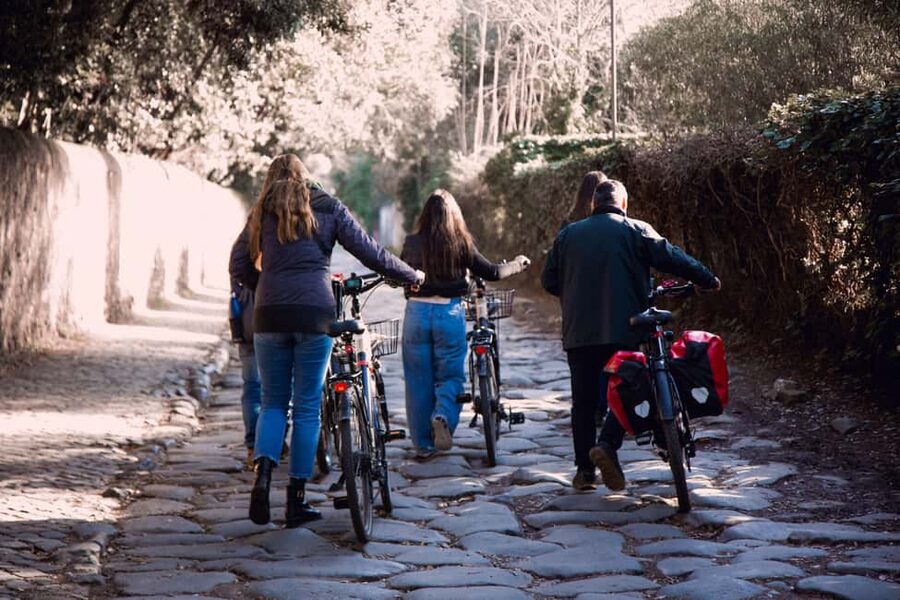
The Appian Way, or Via Appia Antica, began in 312 BC under the Roman censor Appius Claudius Caecus. It was built to connect Rome with Brindisi and became one of the ancient world’s great roads. Today, its surviving stones pass tombs, villas, churches, and fields rather than modern shopfronts.
That is what makes this tour different from a standard Rome sightseeing circuit. You are not simply looking at ruins from a pavement. You are moving through the setting that connects them. The road, walls, grass, trees, and scattered monuments help you understand how far Rome once extended beyond its famous center.
The survival of this area was not guaranteed. During Italy’s postwar economic boom, housing development threatened the countryside around Rome. Archaeologist, urban planner, journalist, and politician Antonio Cederna fought to protect the Appian Way from uncontrolled construction. The Appian Way Archaeological Park is dedicated to his efforts.
I find that context useful because it explains why the route feels so unusual today. The preserved countryside is not accidental. It exists because someone argued that ancient roads and open land were worth saving.
More E-Bike Tours in Italy
- Rome EBike Tour: Appian Way, Catacombs & Roman Aqueducts
★ 5.0 · 1,766 reviews - Rome: Top Highlights & Hidden Gems Tour by Cannondale E-Bike
★ 4.9 · 1,760 reviews - Rome: Appian Way & Aqueducts E-Bike Tour (Catacombs & Food)
★ 4.9 · 1,498 reviews
Starting near Circus Maximus
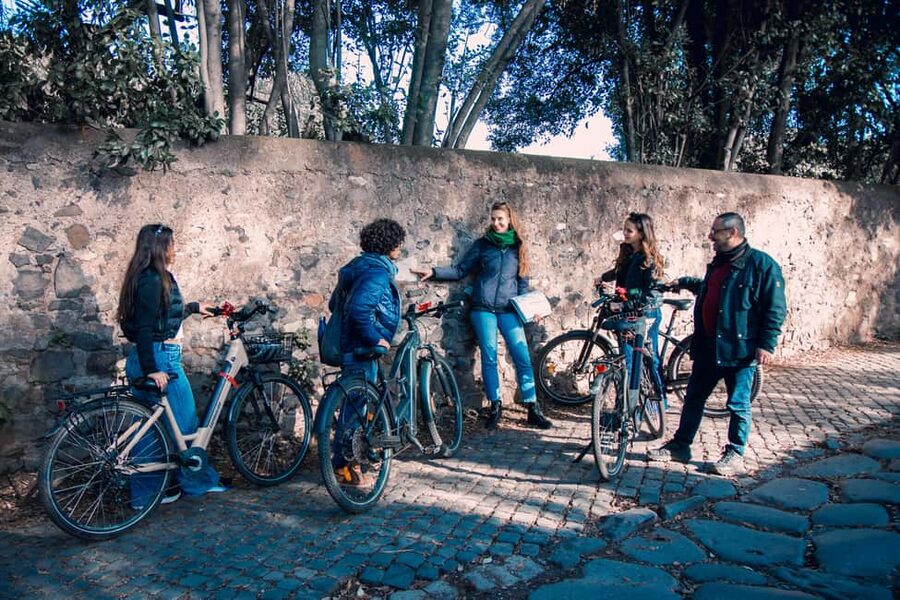
The tour begins at the Rome in a Day Tours venue in front of Circus Maximus. Arrive 15 minutes early so you can become familiar with the bike and complete the required paperwork.
Circus Maximus was the largest stadium built in the Roman world, with room for an estimated 300,000 spectators at chariot races. The first photo stop lasts about 10 minutes, giving your guide a chance to set the scene before the ride heads toward the Appian Way.
This starting point is also practical. You do not begin in one of Rome’s most congested tourist zones. Several riders appreciated starting near Circus Maximus because it made the first part of the journey less stressful than setting off from a busier central street.
You will receive an electric bike and a basic introduction to its controls. The bikes have been described as well maintained, fully charged, and good quality. Still, you should know how to ride a conventional bicycle before joining. The e-bike offers help with effort, but it does not remove the need to balance, steer, brake, and watch the road.
Caracalla, the city walls, and Domine Quo Vadis
The first major stop is the Baths of Caracalla, where you pause for about 20 minutes. These enormous public baths introduce one of the main subjects of the day: Rome’s water system. The aqueducts later in the route will make more sense after you see the scale of the buildings that depended on a steady water supply.
From there, the ride continues to Porta San Sebastiano. This gate is part of the Aurelian Walls, Rome’s defensive circuit. The stop gives you a close look at how the city controlled movement through its boundaries. It also marks a shift from the dense urban core toward the ancient road and its surrounding parks.
At the Church of Domine Quo Vadis, you have around 20 minutes to visit. The church is linked to the Christian tradition that Saint Peter met Christ here while fleeing Rome. The tour does not treat the Appian Way as a single-period attraction. Roman engineering, imperial monuments, early Christianity, and later rural life all appear along the same route.
The catacombs are passed rather than entered, with about 20 minutes devoted to the area. That distinction matters. If you want an underground catacomb visit, this tour does not promise one. Instead, your guide explains the catacomb zone from the route while you continue toward the larger monuments.
Roman villas and tombs along the ancient road
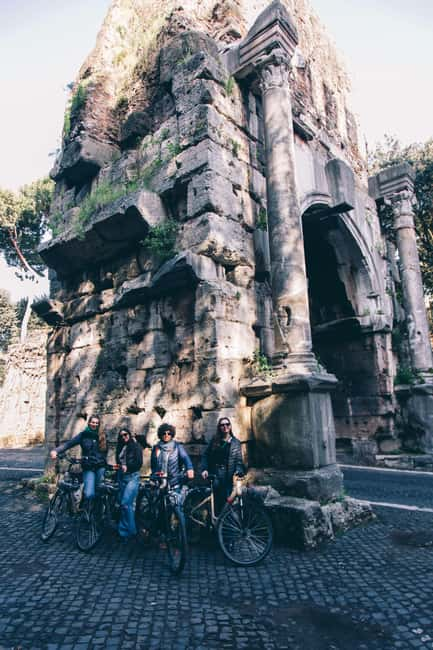
The route continues past the Villa of Maxentius, the Tomb of Cecilia Metella, the Tumulus of the Curiazi, and Villa dei Quintili. These sites are concentrated within the first miles of the Appian Way, so you encounter an unusual number of major remains without long transfers between them.
The Villa of Maxentius recalls the imperial period and gives the road a more personal scale. The Tomb of Cecilia Metella is one of the best-known monuments along the Appian Way, a large cylindrical tomb that has become a symbol of the route. Your stop is listed as a photo stop, so expect an explanation and time to look rather than a full interior visit.
Villa dei Quintili adds another layer. It was a large Roman residence outside the ancient city, showing that the Appian Way was not only a military or commercial corridor. It also served as a setting for grand private estates.
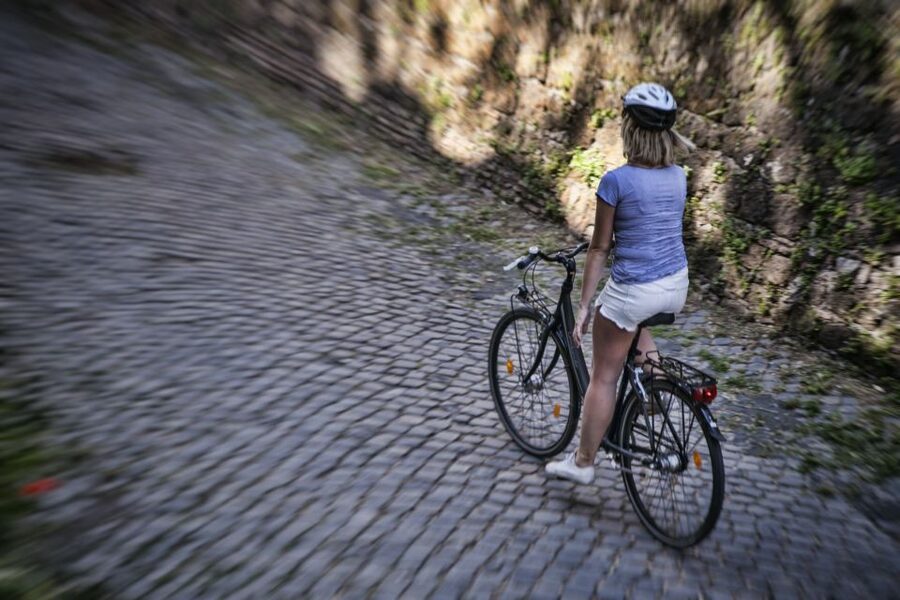
The electric bike is particularly useful here. The old road can be rough, with uneven paving and stretches that feel more like a historic track than a modern street. One rider described the bumpy stones as part of the best part of the experience, while others noted that the assistance made the route much easier. I would agree with that tradeoff: you gain access to a place that would be tiring to cover on foot, but you should not expect a smooth cycle path throughout.
More E-Bike Tours in Rome
- Rome: Appian Way, Catacombs, & Roman Aqueducts E-bike Tour
★ 4.9 · 1,421 reviews - Rome City Small Group Bike Tour with quality Cannondale EBike
★ 5.0 · 1,380 reviews - Rome by Night – Ebike Small Group Tour – Food and Wine (Option)
★ 5.0 · 1,275 reviews - Rome by Night: E-bike Small Group Tour -Food & Wine (Option)
★ 4.9 · 1,233 reviews
A coffee stop before the aqueducts
About halfway through, the group pauses at a local bar for roughly 20 minutes. This is a small detail, but it improves the rhythm of the outing. Four hours on a bicycle can feel long if every minute is movement and commentary. A quick coffee or snack gives you time to rest, cool down, and reset before the open-country section.
The stop is not presented as a meal. Plan to bring any extra food or water you need, especially in warm weather. The tour takes place rain or shine, so your comfort will depend partly on what you wear and carry.
Aqueducts Park and Rome’s water supply
The Aqueducts Park is the visual high point for many people. The tour spends about 30 minutes here, where the remains of Roman water channels stretch across open ground. These structures once carried water into Rome from sources outside the city, allowing the capital to support its baths, fountains, homes, and public buildings.
Here the earlier stop at Caracalla becomes part of a larger story. The baths were not isolated monuments. They depended on an engineering network that moved vast quantities of water over long distances. Seeing the aqueducts in open space helps you understand their size and purpose better than a photograph or museum model can.
The park also changes the pace. Instead of walls and tombs close to the road, you have broad views and long stretches of ancient masonry. You can expect photo stops and explanations rather than a formal archaeological excavation visit.
The route through the park is not just sightseeing from a paved promenade. It is described as a cross-country ride, so uneven ground is part of the plan. The e-bike gives you extra power, but you still need to handle the bike carefully. If you are a nervous cyclist, ask yourself whether rough paths and occasional road crossings sound enjoyable before booking.
Caffarella Valley and a rural side of Rome
From the Aqueducts Park, the ride follows the Almone River toward Caffarella Valley. This is where the tour becomes less like a city excursion and more like a countryside ride, even though central Rome is still close.
You may see horses, sheep, goats, and pigs in the valley. That mixture of farm animals and ancient remains is one of the route’s most appealing features. It gives you a sense of Rome as a living region, not only a collection of monuments preserved behind barriers.
The Nymphaeum of Egeria is another notable stop in the area. It is thought to have belonged to the villa of Herodes Atticus. Water, trees, open land, and Roman remains come together here in a way that feels very different from the Colosseum or Trevi Fountain.
This section is also why I would not treat the tour as simply an alternative means of transportation. The bike is the tool, but the real experience is the transition from imperial infrastructure to open parkland. You get archaeology, nature, and light exercise in one half-day outing.
What the guides add
The guide makes a major difference on this route because the sights are spread out and many are easy to misread without context. Guides who have led this tour include Monica, Monika, Adriana, Alannah, Federico, Frederik, and Martin.
Monica has been especially appreciated for her command of Roman history, attention to safety, and ability to adapt the pace. Adriana has extended the route for a particularly quick family group, adding sights when time allowed. Federico was praised for giving detailed explanations and answering questions, while Martin was noted for a patient manner and help with photography.
Those details point to the kind of guide service you can expect: explanation while stopped, practical help with the bikes, and attention to road crossings. One family felt comfortable because Adriana kept the group together, used crossings, and stopped traffic when necessary. That does not mean every road section is traffic-free. It means the guide takes the cycling conditions seriously.
The tour is offered in English and Dutch. With no more than eight participants, you have a better chance to hear the guide and ask questions than on a large coach outing. Group size can vary, and one family happened to have the guide to themselves, but you should book expecting a small group rather than a private tour.
Safety, comfort, and the practical tradeoffs
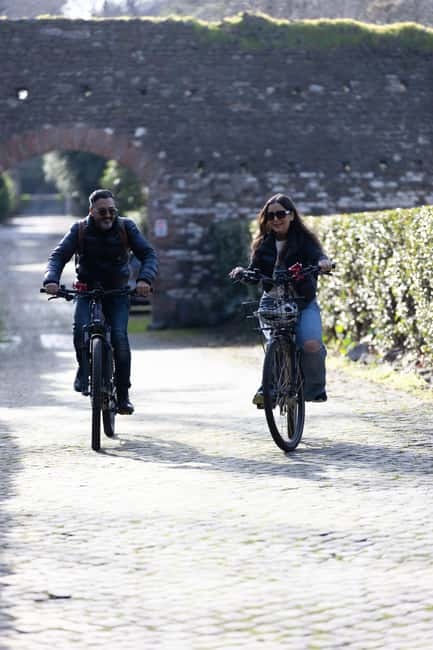
I would rate this as a good choice for competent cyclists, including families with older children. The minimum age is 12, and children aged 14 and 16 successfully handled the ride in one family group. The fact that you ride mainly on quieter roads and park paths helps, but the route still includes city riding and crossings.
The tour is not suitable for people who cannot ride a bike, people with mobility impairments, or pregnant women. Closed-toe shoes are required. Wear comfortable clothes that can get dirty, since dust and rough paths are part of the setting.
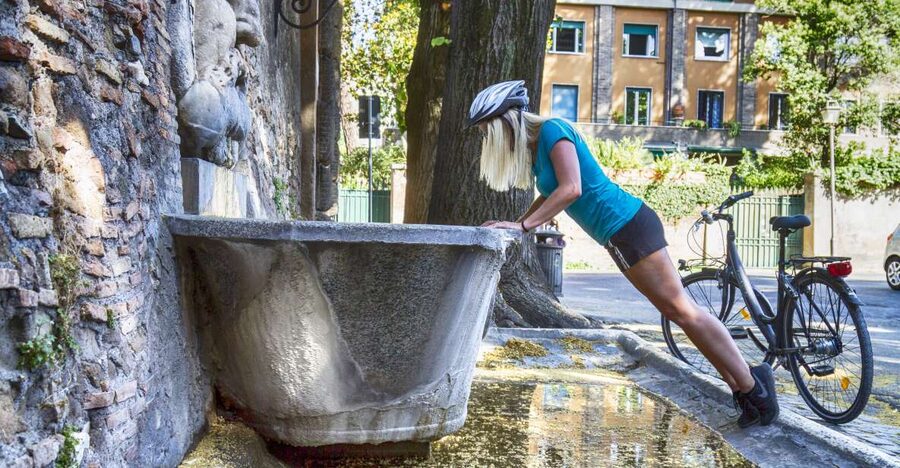
Summer heat deserves attention. One July outing included frequent stops at shade and fountains, but you should still plan for warm conditions. Spring and autumn may offer easier riding temperatures, while winter outings can be pleasant if you dress for the weather. Since the activity runs rain or shine, check the forecast and bring suitable layers.
The bikes are a strong part of the value, but fit matters. One smaller rider found that the available bike did not fit quite as well as hoped. At the shop, take time to check the seat height and frame size before setting off. If you are short or between sizes, say so clearly during the fitting.
Is $88 a fair price?
At $88 per person, this is not the cheapest way to see Rome’s outskirts. But the price includes a four-hour guided experience, the e-bike, and a route that would be difficult to cover efficiently on foot or by public transportation.
The value is strongest if you want more than isolated photo stops. You get a guide who connects the monuments, the water system, the defensive walls, the Christian sites, and the countryside. You also avoid spending the entire day in central Rome’s queues and crowded streets.
The price is less attractive if you only want to see the aqueducts quickly or if you dislike cycling on uneven surfaces. In that case, a shorter visit by another form of transport may suit you better. For an active half-day with a small group and substantial guiding, I consider $88 reasonable.
Free cancellation up to 24 hours before the start and the option to reserve now and pay later make it easier to fit into a changing Rome schedule. Check the available start times when booking, since the duration is four hours.
Who should book this ride?
I would choose this tour if you have already seen some of central Rome and want a change of pace. It works especially well for people interested in archaeology, Roman engineering, early Christian sites, photography, and outdoor activity.
Families with confident cyclists can enjoy it, though parents should judge their children’s comfort around traffic and rough ground honestly. The small group limit and careful guides help, but they do not turn the route into a beginner cycling lesson.
I would skip it if you cannot ride a bicycle, need step-free access, are pregnant, or want a fully polished road surface. I would also think twice if rain would spoil your day, because the tour runs in all weather.
Final verdict: a strong half-day outside central Rome
I recommend this e-bike tour for visitors who want to see Rome’s ancient world in its original setting rather than only from the city center. The best parts are the preserved Appian Way, the scale of the aqueducts, and the sudden quiet of Caffarella Valley.
The route is active, occasionally bumpy, and not suitable for every body or cycling level. But if you can ride confidently, the electric assistance turns a demanding sightseeing day into a manageable one. For $88, you get a small group, a well-equipped bike, a local guide, and access to a side of Rome that many visitors never reach.
FAQ
How long does the e-bike tour last?
The tour lasts four hours, including the stops along the Appian Way, at the aqueducts, and in Caffarella Valley.
Where does the tour start?
It starts at Rome in a Day Tours, Electric Bike and Vespa Excursions, in front of Circus Maximus.
How early should I arrive?
Arrive 15 minutes before the start so you can become familiar with the bike and complete the paperwork.
What languages are available?
The tour is available with a live guide in English or Dutch.
How large is the group?
The group is limited to eight participants.
Is the e-bike included?
Yes. An e-bike and an experienced tour guide are included.
Can I join if I cannot ride a bicycle?
No. You need to know how to ride a bicycle to join the tour.
Is the tour suitable for children?
Children under 12 cannot join. Children aged 12 and older may participate if they can ride confidently and manage the route.
What should I wear and bring?
Wear comfortable clothes that can get dirty and closed-toe shoes. The tour runs rain or shine, so dress for the weather.
New cycling reviews around Rome
- Rome: Panoramic Off-the-beaten-track Cannondale E-Bike tour★ 5.0 · 71 reviews
- Rome: Full-Day Guided Tour by E-Bike with Lunch Included★ 4.9 · 36 reviews
- In Rome like a star: e-bike tour with photo shoot★ 4.9 · 20 reviews
- Rome :guided night e-bike tour with typical ice-cream★ 5.0 · 55 reviews
- Hidden Rome: Small Group E-Bike Tour with Street Food Stops★ 4.9 · 144 reviews
- Rome: E-Bike Sunset Tour with Pizza Option★ 4.9 · 428 reviews
- Rome: Early Morning E-Bike Tour★ 4.9 · 84 reviews
- Rome E-Bike Highlights Tour & Tasting in Secret Cave★ 4.7 · 16 reviews
Rome Cycling Tours, compared.
Rome EBike Tour: Appian Way, Catacombs & Roman Aqueducts
Read our review →
Rome: Top Highlights & Hidden Gems Tour by Cannondale E-Bike
Read our review →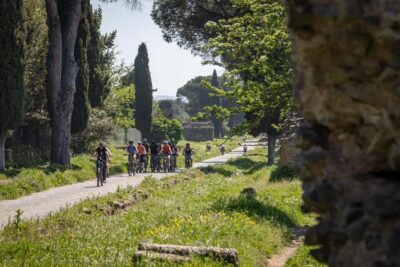
Rome: Appian Way & Aqueducts E-Bike Tour (Catacombs & Food)
Read our review →
Rome City Small Group Bike Tour with quality Cannondale EBike
Read our review →
Rome by Night – Ebike Small Group Tour – Food and Wine (Option)
Read our review →
Appian Way Aqueducts Bike Tour (Catacombs & Lunch Option)
Read our review →
Rome: Standard or E-Bike Highlights Guided Tour
Read our review →
Browse the lists this ride appears in