
Review · BERLIN
Berlin: Private Bike Tour of the Berlin Wall and Third Reich
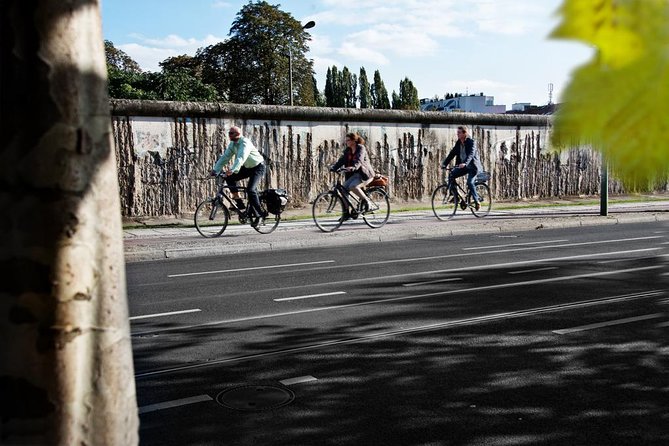
Berlin’s past is spread across a large city, and a bicycle is a smart way to connect the pieces. In about three hours, you can move from the medieval Nikolaiviertel to the Berlin Wall, Nazi-era ruins, Hitler’s bunker site, and Checkpoint Charlie without losing much time between stops. The tour is especially good for history-minded visitors who want context instead of a quick photo at each sight.
I like the private format, which lets your group ask questions and adjust the route. I also like the mix of famous and lesser-known places, including Günter Litfin’s preserved watchtower, Invalidenfriedhof, and the Humboldthain flak tower. The main consideration is pace: ten minutes at many stops is enough for a clear explanation, but not enough for a long museum visit or detailed exploration.
Key points to know before you book
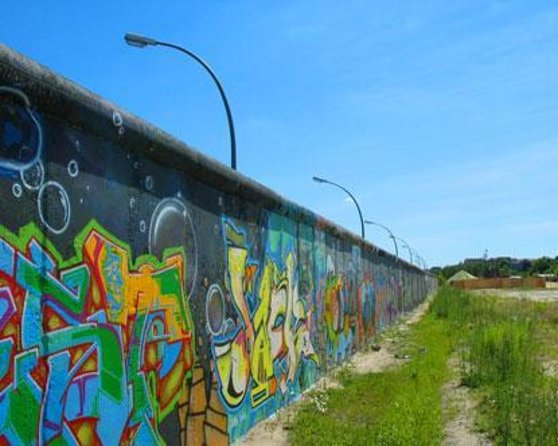
- The Wall Memorial is the strongest historical stop: It is one of the few places where the border’s layout and purpose are still easy to understand.
- You cover a lot of ground by bike: A previous rider found that cycling made it possible to see far more than on foot in the same period.
- The route reaches beyond the usual highlights: Mauerpark, Invalidenfriedhof, and the Günter Litfin Memorial add useful detail to the better-known sights.
- The English route includes Checkpoint Charlie: This stop is specifically offered on the English version of the tour.
- The tour is private but requires at least four people: Your group rides together, with bicycles, helmets, and child seats available on request.
- The itinerary can be adjusted: Each guide creates a route, so the exact order and emphasis may vary.
Why a bicycle works so well for Berlin’s divided past
Berlin is not a city where all the major Cold War and Nazi-era sites sit in one compact historic center. The Wall cut through several districts, and important places now sit beside parks, offices, apartments, and government buildings. Walking between them can eat up much of a short visit.
A bicycle solves that problem. You get the speed to connect distant locations, yet you can stop quickly at a memorial, street corner, or section of surviving Wall. The supplied bicycle and helmet are included in the price, so you do not need to arrange a separate rental.
The route lasts about three hours. That is long enough to create a useful map of Berlin’s twentieth-century past, but short enough to fit into a busy sightseeing day. You should expect a moving lesson with frequent stops, not a slow museum tour.
The guide leads a private group, and the Free Berlin concept allows each guide to shape the route. That matters here because your interests may be different from another group’s. You can ask for more Cold War detail, more Nazi history, or more attention to Berlin’s political center.
More Private Cycling Tours in Berlin
- Private Berlin Street Food Tour by Bike
★ 5.0 · 87 reviews - The Beauty of Berlin by Bike: Private Tour
★ 5.0 · 59 reviews - Private Berlin Street Food Bike Tour
★ 4.9 · 42 reviews
Nikolaiviertel and the synagogue: a city rebuilt and remembered
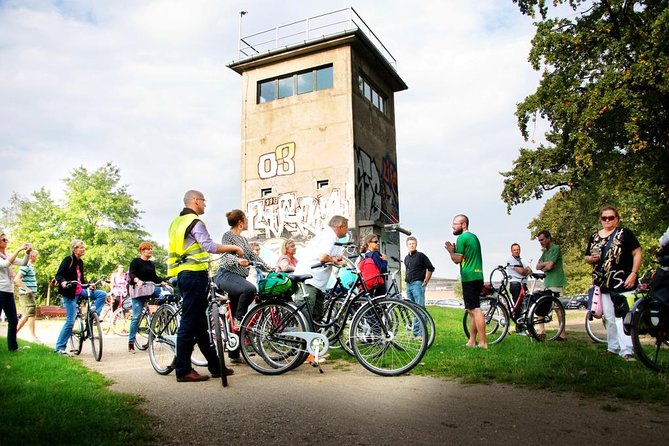
The tour begins at Nikolaiviertel, described as Berlin’s only real old town. The name can be misleading if you picture an untouched medieval quarter. Much of Berlin was damaged during the Second World War, and this area raises an important question right away: how old is old when a city has endured such destruction and rebuilding?
That makes this a useful opening. You begin with Berlin’s physical past before moving into its political and military past. The stop is brief, about ten minutes, so expect an introduction rather than a full architectural tour.
Next comes the New Synagogue on Oranienburger Strasse, home to the Centrum Judaicum. The stop focuses on the story of a police officer who protected the building during Kristallnacht, the November 1938 pogrom known as the Night of Broken Glass.
The visit is short, around five minutes, and is mainly about the act of civil courage. You will not have time for a full look inside the institution, but the story gives the building a human focus. It also reminds you that Berlin’s wartime story includes individual choices, not only government orders and military events.
The Berlin Wall Memorial gives the clearest picture
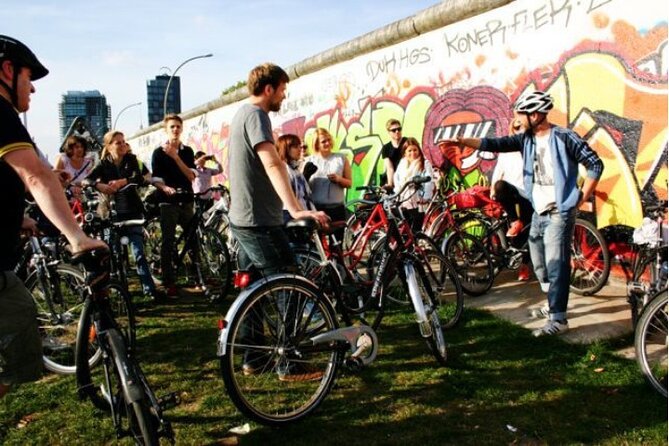
The Berlin Wall Memorial is likely the most useful stop for anyone trying to understand how the border worked. The tour points out that only a few places still allow you to see and grasp the Wall as a complete system rather than as isolated slabs of concrete.
That distinction matters. At many central Berlin sites, the Wall survives as a narrow strip or a painted fragment. Here, the setting can help you picture the barriers, the controlled zone, and the way the border divided ordinary neighborhoods.
The stop lasts about ten minutes. You should expect a focused explanation and time to look around, not a long visit to every part of the memorial site. Even so, this is where the tour’s bike format pays off. You arrive with the Wall’s wider route already in mind and can connect what you see to the next locations.
For a first visit to Berlin, I would give this stop more weight than a quick photo at Checkpoint Charlie. It provides the clearest physical sense of what the border did to the city.
Mauerpark and Humboldthain reveal the border’s planning
Mauerpark is now associated with Sunday flea markets, but its earlier role was far more severe. The tour uses it to explain East Germany’s repeated attempts to create what its rulers considered a perfect border.
The ten-minute stop gives you a chance to see how a public park can conceal a difficult past. You might find the contrast striking: a place used for leisure today once formed part of a controlled frontier. The guide can also help connect Mauerpark to the wider Wall system rather than treating it as an isolated stop.
At Humboldthain, the subject shifts to Nazi architecture and wartime defense. The flak tower was both a huge military installation and an air-raid shelter. Its elevated position offers a broad view across Berlin, while its remains point to the scale of the regime’s construction plans.
This stop combines a view with a physical reminder of war. You see how large and imposing these structures were meant to be, even when their original purpose was destruction and defense. The stop is scheduled for about ten minutes, so the panoramic view is part of the appeal.
More Private Cycling Tours in Germany
- Private Highlights of Berlin Bike Tour
★ 5.0 · 13 reviews
Günter Litfin and Invalidenfriedhof add human scale
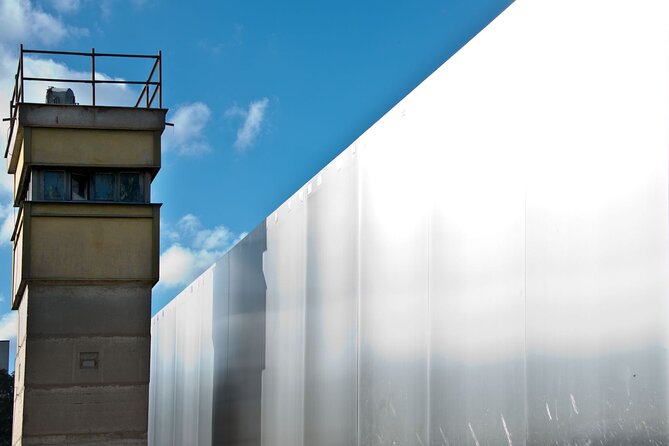
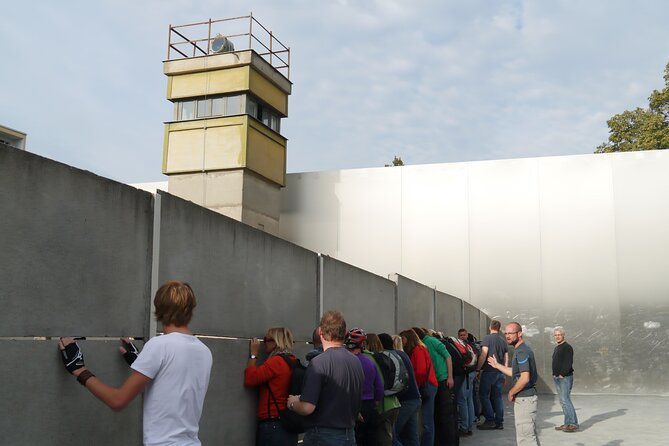
The Günter Litfin Memorial preserves an original watchtower. It commemorates Günter Litfin, identified as the first person shot at the Wall. A preserved tower gives this part of the tour a direct, physical quality. Instead of only hearing that the border was guarded, you can see the kind of structure used to control it.
The stop is brief, but the subject is personal and hard to reduce to a simple political story. The Wall was not only a line between systems. It was a place where people tried to cross and sometimes died for doing so.
Invalidenfriedhof brings another layer of German history. The cemetery was created for military figures and was later cut through by the Wall. Some people buried there were celebrated as heroes in their own time, while the tour encourages a more careful look at whom Germany chooses to honor and whom it needs to remember critically.
This is one of the route’s less predictable stops. You do not come only for a famous landmark. You come to see how Berlin’s military past, Nazi rule, and Cold War division overlapped in the same ground.
Spreebogenpark and the Reichstag explain power
From Spreebogenpark, you get a view over Germany’s government district. The location is useful because the modern political center sits close to sites tied to dictatorship and war.
The discussion also turns to Albert Speer, Hitler’s architect, and his plan for a Great Hall that could have held 180,000 people. The figure is so large that it helps you understand the regime’s taste for monumental scale. This is not just an architecture story. It is a story about power, mass politics, and the attempt to make government appear permanent and overwhelming.
At the Reichstag, the guide discusses Hitler’s rise to power and Germany’s democratic history. You do not go inside during this tour, so set your expectations accordingly. The value comes from the exterior setting and the explanation of how the building fits into Germany’s political story.
If entering the Reichstag is important to you, you will need to arrange that separately. This tour is about seeing the building as one part of a larger route, not touring its interior.
Holocaust memorials and the bunker site require quiet attention
The route includes the Memorial to the Murdered Jews of Europe near Brandenburg Gate, along with references to memorials for other major victim groups of the Holocaust. The main memorial is made up of a large field of concrete blocks, and its scale can be difficult to take in from one viewpoint.
The guide’s role here is important. You need historical context to understand why the memorial was built, what it represents, and how its design asks you to move through the space. The stop lasts about ten minutes, so you will receive an introduction rather than a long period for solitary reflection.
The tour also visits the site of Hitler’s Führerbunker. Today, the spot is a parking area. That plain setting is deliberate and gives the guide a chance to explain why no grand visible ruin marks the place where Hitler spent his final weeks and died by suicide.
Do not expect a dramatic bunker entrance. The point is the absence of one. A parking lot can seem anticlimactic, but it also avoids turning the site into a shrine. This is a place where the explanation matters more than what you see.
Checkpoint Charlie brings the Cold War story into focus
Checkpoint Charlie is the best-known border crossing on the route. On the English version of the tour, the guide explains its role as a crossing associated with the United States and the Soviet Union. The stop also covers the moment when a confrontation there brought the world close to a much wider conflict.
The site is famous, but fame can make it easy to miss the history. The tour gives you the political setting behind the checkpoint instead of leaving you with only a photo opportunity.
Checkpoint Charlie is included specifically in the English tour. If you book another language, confirm the route before you go, since the provided details only promise this stop for English-language departures.
The East Side Gallery is also listed among the tour’s highlights. Since the route is flexible and each guide designs a version of it, ask at the start if seeing it is a priority for your group. That is one of the advantages of booking privately: you can make your interests clear before the ride begins.
Price, group size, and practical value
The price is $107.42 per person. That is not a budget bicycle rental, but it includes a professional guide, bicycle, helmet, and private touring for your group. The value depends heavily on group size and how much you want historical explanation.
For four people, the minimum required group, you are paying for a shared private experience rather than four separate public tour places. You also avoid spending much of the morning or afternoon walking between far-flung sites. One rider specifically valued the speed of the bicycles and estimated that seeing the same sights on foot would have taken twice as long.
The tour is a better buy for people who want an organized history route than for people who simply want to pedal around Berlin. It is also a sensible choice if your time is limited and you want to cover both the Wall and Third Reich sites in one outing.
Several departure times are available, giving you room to fit the ride around other plans. The meeting point is Free Berlin Bike Tours and Rental at Poststrasse 11, near the Nikolaiviertel starting area. The tour returns to the same meeting point, so you do not need to arrange a ride back from another district.
The tour operates in all weather. Wear clothing suited to the forecast, and remember that a bike ride can feel colder than a walking tour. Children are welcome, but they must be accompanied by an adult. Infant seats can be provided on request.
English and German are available. Dutch, French, and Spanish may also be possible on request. Confirmation is provided at booking, and free cancellation is available up to 24 hours before the start time. Cancellations or changes inside that window are not refunded or accepted.
Who will get the most from this ride
I would choose this tour for a group of friends, a family with older children, or a couple traveling with other relatives who want a private route. It suits people who prefer questions and conversation to a fixed public group.
History buffs will get the most from it, especially if they want to connect Nazi Berlin, the Holocaust, the Cold War, and reunified Germany in one outing. The itinerary also works for first-time visitors because it introduces the city’s major political areas while adding places you might not find on your own.
You should think twice if you dislike cycling, want extended time inside museums, or prefer to explore each memorial at your own pace. Ten-minute stops are useful for orientation, but they are not enough for deep individual study.
Should you book the Berlin Wall and Third Reich bike tour?
Book it if you want to cover a lot of Berlin efficiently and care about the meaning behind the sights. The combination of a private guide, flexible route, included bike, and access to both famous and less obvious sites gives you a strong three-hour introduction.
Ask for your priorities at the beginning. If Checkpoint Charlie, the East Side Gallery, or a particular Wall site matters most, say so before setting off. The route is designed to adapt, and that flexibility is one of its best features.
Skip it if you want a leisurely ride with few stops or a full museum visit. For a compact, serious, and practical look at Berlin’s twentieth-century story, though, this is a well-priced way to get your bearings fast.
FAQ
How long does the private bike tour last?
The tour lasts approximately three hours.
Where does the tour begin and end?
It begins at Free Berlin Bike Tours and Rental, Poststrasse 11, 10178 Berlin, Germany. The activity ends back at the same meeting point.
What is included in the price?
The price includes a professional guide, bicycle, helmet, and private touring for your group.
How many people are required to book?
The tour operates with a minimum of four people.
Is Checkpoint Charlie included on every language version?
Checkpoint Charlie is included on the English version of the tour. English and German are available, with Dutch, French, and Spanish possible on request.
Can children join the tour?
Yes. Children are welcome, but they must be accompanied by an adult. Infant seats can be provided on request.
What happens if the weather is bad?
The tour operates in all weather conditions, so you should dress appropriately for the forecast.
New cycling reviews around Berlin
- Private Highlights of Berlin Bike Tour★ 5.0 · 13 reviews
- From Berlin: Gardens & Palaces of Potsdam Bike Tour★ 5.0 · 61 reviews
- Berlin: Small Group Bike Tour Through City Center★ 4.9 · 64 reviews
- Berlin: Top secret bike tour and hidden gems of the city★ 4.8 · 411 reviews
- Berlin: Illuminated Berlin by Bike Taxi★ 4.8 · 162 reviews
- Berlin: From East to West & Wall Tour by Bike with a Guide★ 4.8 · 171 reviews
- Berlin: Green City Guided Bike Tour★ 4.6 · 29 reviews
- Berlin (E)Bike Tour Historical Highlights in Small groups★ 4.5 · 24 reviews
Berlin Cycling Tours, compared.
Berlin: Sights and Highlights Bike Tour with a Local Guide
Read our review →
Berlin Highlights Sightseeing Bike Tour in Small Groups
Read our review →
Berlin: The Wall and Third Reich Guided Bike Tour
Read our review →
Berlin: Alternative Bike Tour of Kreuzberg & Friedrichshain
Read our review →
Berlin: Guided Bike Tour to Explore the Highlights
Read our review →
Berlin: Cold War & Berlin Wall History Guided Bike Tour
Read our review →Browse the lists this ride appears in