
Review · THE WORLD
Bucharest: Communist Bike Tour
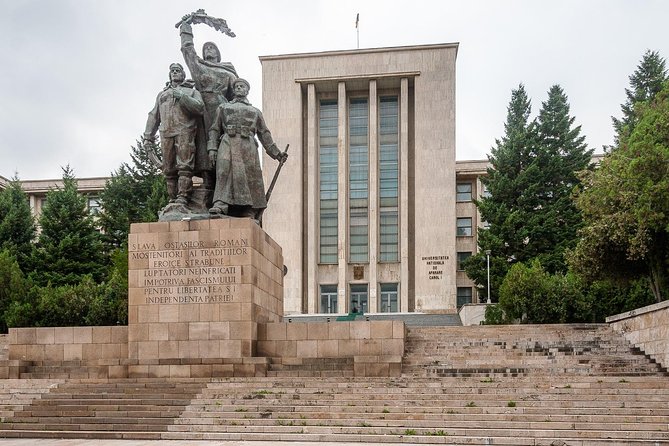
Bucharest’s communist past is too spread out for a tidy walking tour. This four-hour bike ride links the Old Town, Coral Temple, the first Romanian parliament, a Stalin-era district, Casa Radio, and Revolution Square. The route shows how political power changed the city, not just where a few monuments happen to be.
I like the way the bicycle gives you a wider view of Bucharest than a walking tour can, and I like that the guide adds political, economic, religious, and everyday context. Guides Horia and Alex have been especially praised for clear explanations and friendly help. The main drawback is simple: you need to be comfortable riding in city traffic, and the tour is not suitable for people with limited mobility.
Key points to know before booking
- Four hours on two wheels: You cover a broad section of central Bucharest without spending the whole day on foot.
- A political story with real locations: The route follows the communist movement, Soviet occupation, Ceaușescu’s rule, and the 1989 Revolution.
- Coral Temple adds needed context: The tour connects Bucharest’s Jewish community with the early communist movement.
- Casa Radio shows unfinished ambition: This huge incomplete project helps explain the scale of communist urban planning.
- Revolution Square gives the route a strong finish: You end where Ceaușescu made his last speech and the 1989 uprising began.
- Bring comfortable shoes and expect no meal stop: Bikes, helmets, and locks are included, but food and drinks are not.
Why a bicycle makes sense in Bucharest
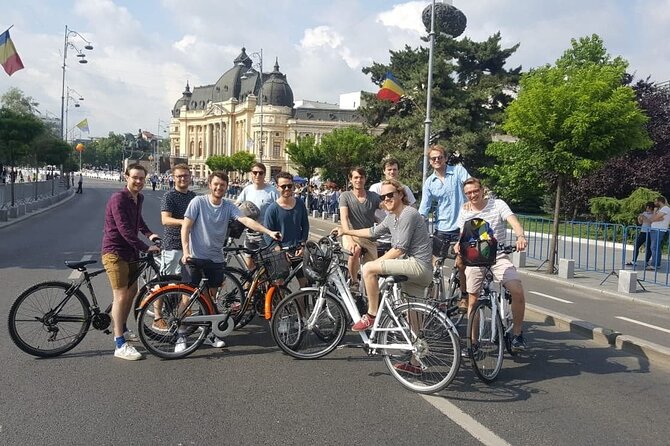
Bucharest is a large city, and the places tied to communism are not all gathered around one square. A walking tour could explain the same story, but it would either cover less ground or spend a good part of the day moving between sites.
A bicycle lets you connect the city’s older center with its later political districts. You get the useful middle ground between a bus tour and a slow walk. You see the streets between the major stops, which matters here because the communist story is partly about how whole areas were reshaped.
This is not a sightseeing ride built around grand views or postcard stops. It is a history tour with cycling as the practical tool. You will pause for explanations, then ride on to the next piece of the story.
The route lasts four hours, so plan for an active morning or afternoon. Comfortable shoes are the only stated item to bring, but I would also choose clothes suited to riding and leave a large bag behind if possible. Food and beverages are not included, so eat before you set off.
More Cycling Trips in the world:
- Lion City Bike Tour of Singapore
★ 5.0 · 6,211 reviews - Big Bike tour Amsterdam – See all in 3 unforgettable hours
★ 4.7 · 4,929 reviews - 3-Hour Porto Highlights on a Electric Bike Guided Tour
★ 5.0 · 4,392 reviews
Starting in the Old Town and seeing what was lost
The meeting point is just across from Hanu’ Berarilor, at Casa Oprea Soare. From there, the guide begins in Bucharest’s old city center, a fitting place to discuss the damage done during the communist period.
The Old Town is not presented simply as a pleasant collection of old streets. The opening talk focuses on how the communist era harmed this historic part of Bucharest. That gives you an early lesson in the tour’s method: buildings and streets are treated as evidence of political decisions.
The Old Town section should appeal to you if you want more than dates and leaders. You begin with the effect of government policy on the city itself, then move toward the political events that helped shape those policies.
This first stage also helps you get used to the bicycle and the pace. The tour is not described as a race, but you should still be ready to ride through an urban setting. If cycling in dense traffic makes you uneasy, this is the point to consider that carefully before booking.
Coral Temple and the early communist movement
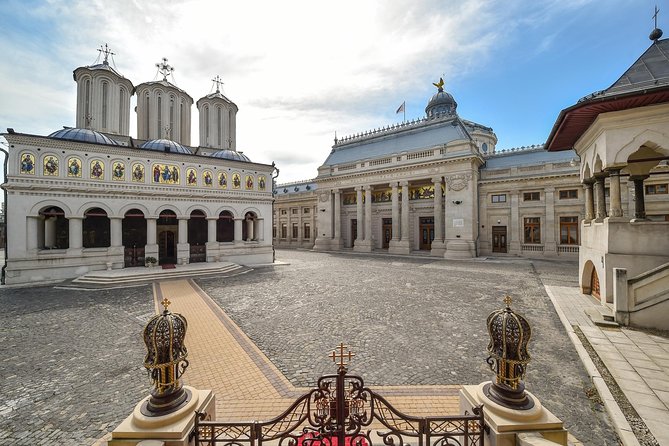
The next stop is Coral Temple, one of the route’s more unexpected choices. The tour uses the Jewish community as part of the story of the early communist movement in Romania, particularly its role among the people who helped initiate that movement in the early 1920s.
This stop gives the tour a broader frame. Instead of treating communism as something that simply arrived after the Second World War, the guide traces earlier political currents and local involvement. That matters because Romanian communism developed through more than one stage.
Coral Temple also keeps the route from becoming a parade of government buildings. You get a religious and community setting before moving on to the violent political events that followed. The change of subject should make the larger story easier to follow.
The supplied route information does not promise entry into the temple, so you should expect the stop to focus on the site and the guide’s explanation rather than a full interior visit. The value here is the context, not a long architectural tour.
The first Romanian parliament and a communist bomb attack
The tour then moves to the site of the communist bomb attack against Romania’s democratic government, identified as the first Romanian parliament. This is one of the route’s most important stops because it shows the movement in direct conflict with the country’s existing political system.
The guide places the attack within the broader story of the communist movement. You are not just looking at a building and hearing its name. You are following the shift from political organizing to an attempt to destroy democratic authority.
That connection between place and event is one of the tour’s strongest features. It gives you a concrete reference point for a period that can otherwise feel abstract. The stop should be particularly useful if your knowledge of Romanian history begins with the postwar Soviet occupation or Ceaușescu.
The route is designed to keep moving through the city, so do not expect a museum-style presentation at every location. You will likely get the most from this part if you listen closely to the guide’s timeline and ask questions when the group pauses.
Same roads, a different ride:
- Ninh Binh Full-Day Tour from Hanoi to Hoa Lu, Tam Coc & Mua Cave Via Boat & Bike
★ 5.0 · 4,384 reviews - Small Group Guided Bike Tour of Amsterdam’s Hidden Gems
★ 5.0 · 3,936 reviews - 3-hour Complete Prague Bike Tour
★ 5.0 · 3,674 reviews - Bangkok: Temples, Canals & Local Life Bike Tour
★ 4.9 · 3,511 reviews
The Soviet occupation and the district built for communist elites
After the early movement, the tour advances to the period following the Second World War, when Romania was occupied by the Soviet Union for 12 years. The route passes through a neighborhood where Russian army generals responsible for governing the country lived.
This is a useful change in scale. The earlier stops focus on political action and conflict. Here, the tour shows how power was expressed through housing and urban space. A district built for the ruling elite tells you who received privilege under the new system and how foreign influence was made visible in daily life.
The neighborhood is described as one built for communist elites during the Stalin era. That phrase is important. You are not simply seeing old apartment blocks or a former residential quarter. You are seeing a planned environment connected to a narrow group at the top of the political order.
This portion also explains why a bicycle is helpful. You can pass through a larger area and see the relationship between districts rather than viewing one isolated building. The tradeoff is that the experience depends heavily on the guide’s narration. Without the historical explanation, the architecture may look less distinctive than the story behind it.
Casa Radio and the scale of unfinished ambition
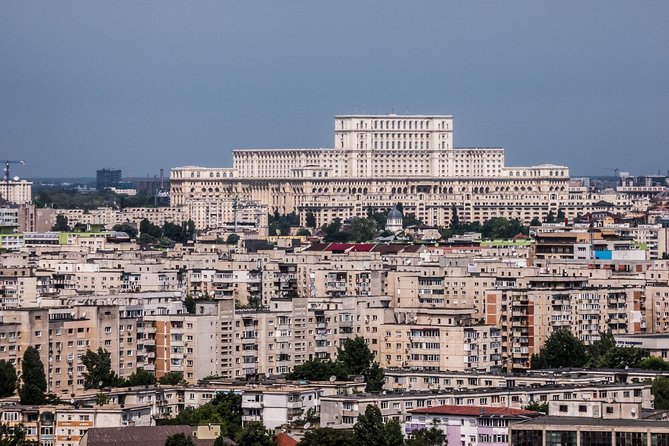
One of the tour’s headline sights is Casa Radio, described as the biggest unfinished communist urban project in Bucharest. It is a strong example of the grand scale of communist planning and the gap between political ambition and completed reality.
Huge unfinished buildings can be difficult to understand from a photograph. Seeing Casa Radio as part of a moving city route gives you a clearer sense of its place in Bucharest. The project is not treated as a polished monument. Its incomplete condition is the point.
The route information also refers to the National History Museum in this final section, describing buildings that were completely reshaped by the communist regime. Because both Casa Radio and the National History Museum are named in the tour description, you should listen for how the guide distinguishes the unfinished project from the altered historic buildings.
That possible overlap is worth noting before you book. The headline highlights Casa Radio, while the detailed route also names the National History Museum. The safest expectation is a broader look at communist reshaping of Bucharest, with Casa Radio as the clearest unfinished-project example, rather than assuming a long indoor museum visit.
Revolution Square and Ceaușescu’s last speech
The final stop is in front of the former Communist Central Committee, at Revolution Square. This is where Ceaușescu delivered his last speech, and where the Revolution began in December 1989.
Ending here gives the tour a clear dramatic arc. You begin with the damage done to the old center, trace early communist activity, examine Soviet influence and elite housing, and finish at the collapse of the regime.
Revolution Square is valuable because it links a public speech to a political turning point. Ceaușescu’s last address was not just another official event. The square became the setting for a breakdown in authority, with the Revolution beginning there in December 1989.
The guide’s explanation is likely to be the most useful part of this stop. You can see the location, but the significance comes from understanding what changed between the planned speech and the events that followed. One advantage of ending here is that you leave with the political story tied to a specific place rather than a loose collection of facts.
The guides and the quality of the explanation
The most important part of this tour is the live English-speaking guide. The cycling itself is a means of reaching the sites, while the explanations turn those sites into a connected story.
Horia receives particular praise for being friendly, helpful, and well informed. One account also credits him with adding subjects beyond communism, including Bucharest’s founding days, the Orthodox Church, and city life today. That suggests you can expect some wider city context rather than a narrow political lecture.
Alex is also praised for giving historical, economic, and political background, along with information about different groups of people in Romania. That wider approach is useful because the communist period cannot be understood through buildings alone.
A guide named Chorea is also associated with a stop across Bucharest, though this may be a spelling variation of Horia. The consistent point is that the guide quality is central to the experience. Ask questions, especially when a site seems ordinary at first glance. The tour is designed to explain why the place matters.
What the $53 price gets you
At $53 per person, this is not the cheapest way to spend four hours in Bucharest. You are paying for a live English-language guide, a bicycle, a helmet, and a bike lock, as well as the chance to cover a wide route without arranging transport between stops.
The value is strongest if you want a structured introduction to the city’s communist past. A good guide can save you considerable time working out how the Old Town, Coral Temple, the former parliament, the Stalin-era district, Casa Radio, and Revolution Square fit together.
The price is less appealing if you mainly want a relaxed ride or a quick look at major sights. This is a content-heavy history tour, and four hours is a serious block of your day. You also need to supply your own food and drinks.
Free cancellation up to 24 hours before the start and the option to reserve now and pay later reduce the risk when your plans are still changing. Check the available start times before booking, since the tour lasts four hours and may shape the rest of your day.
Who will enjoy this tour most
I would choose this tour early in a Bucharest visit if you want a city orientation tied to modern Romanian history. One direct benefit is that the ride can give you ideas for places to return to later, and the route may help you understand parts of the city that feel confusing on a first visit.
It suits you best if you:
- Enjoy history explained through actual places
- Feel comfortable cycling in urban traffic
- Want to cover more ground than a walking tour allows
- Prefer a live guide to reading background material alone
- Are interested in politics, architecture, and city planning
It is less suitable if you have limited mobility or do not feel safe on a bicycle in dense city traffic. The tour is also not ideal if you want a quiet, low-effort activity with lots of time inside museums.
The tour is offered in English. Since food and beverages are not included, plan a meal before or after the ride.
Should you book the Communist Bike Tour?
Book it if you want Bucharest’s communist era explained as a connected story rather than a list of buildings. The route has a strong range: early political conflict, Soviet occupation, elite housing, unfinished urban planning, and the 1989 Revolution.
The best reasons to go are the broad coverage and the guide-led context. Horia and Alex are praised for making the material clear and for adding economic, political, religious, and everyday subjects. The bicycle also helps you see more of Bucharest in one four-hour outing.
Skip it if riding in city traffic would make you tense, or if you need an accessible tour. At $53, the experience earns its price through the guide and the distance covered, not through included meals or long interior visits. For an active visitor who wants a useful first look at modern Bucharest, it is a strong choice.
FAQ
How long is the Bucharest Communist Bike Tour?
The tour lasts four hours.
How much does the tour cost?
The listed price is $53 per person.
What language is the tour offered in?
The live guided tour is offered in English.
Where does the tour meet?
Meet just across from Hanu’ Berarilor, at Casa Oprea Soare.
Are bicycles and helmets included?
Yes. Bicycles, helmets, and bike locks are included in the ticket price.
Is food included?
No. Food and beverages are not included.
Is the tour suitable for people with limited mobility?
No. The tour is not recommended for people with limited mobility.
New cycling reviews around the world
- Riga: Beer or Cider Bike Tour★ 4.7 · 121 reviews
- Riga Explorer Bike Tour★ 4.8 · 127 reviews
- Rio de Janeiro: Guided Bike Tours in Small Groups★ 4.5 · 133 reviews
- Ria Formosa: Guided Bike Tour (3h), Início na Quinta do Lago★ 4.8 · 14 reviews
- Rethymno: Guided e-Bike Tour on Mili Gorge and Soft Drinks★ 4.9 · 36 reviews
- Rhodes: Anthony Quinn Bay E-Bike Tour with Snorkeling★ 4.9 · 15 reviews
- Rhodes: eBike Highlights Tour w/ Personal Photographer★ 4.9 · 99 reviews
- Rent a bike in Amsterdam | 1, 2, 3+ hours★ 4.5 · 68 reviews