

Review · PORTLAND
Bike Around Portland Oregon: Art, Culture, Bridges, Poetry
Portland makes more sense from a bicycle than from a tour bus. This slow-paced ride links rose gardens, street art, river paths, bridges, poetry, and everyday neighborhoods rather than ticking off a short list of monuments.
I like the way the tour shows how Portland lives, especially through Ladd’s Addition, Poet’s Beach, and the waterfront paths. I also like the easy pace, patient guides such as Kelly, Sara, Carrie, Edwin, and Angela, and the included bike, helmet, and water. The main consideration is that Portland weather can change quickly, and you’ll spend about three hours outside on city streets.
Key points to know before you pedal
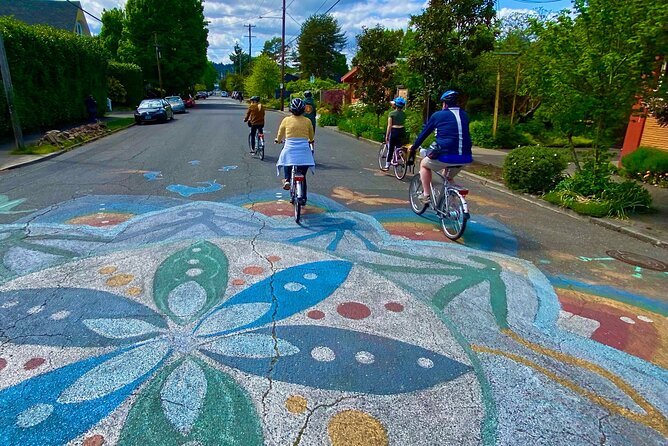
- Ladd’s Addition brings an unusual start: Ride through one of Portland’s most distinctive neighborhoods, with diagonal streets and community rose gardens.
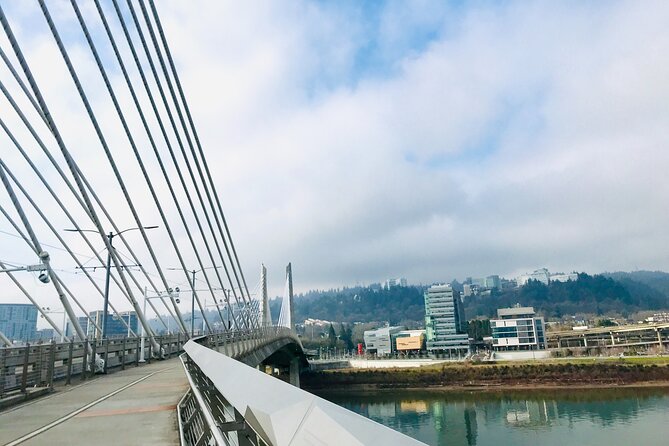
- Tilikum Crossing is the signature bridge: Cross Portland’s car-free bridge for photos, river views, and a look at the city’s transport-minded character.
- The tour favors local texture: You’ll see murals, greenways, student poetry, food stops, older neighborhoods, and public spaces.
- The pace suits sightseeing: Frequent stops make this a ride for looking around, not racing across town.
- The route is mostly flat: One bridge climb may require extra effort, but the ride is designed for ordinary visitors rather than serious cyclists.
- The price covers the essentials: At $47, your bike, helmet, and bottled water are included, while doughnuts, pastries, or ice cream cost extra.
A three-hour introduction to Portland by bike
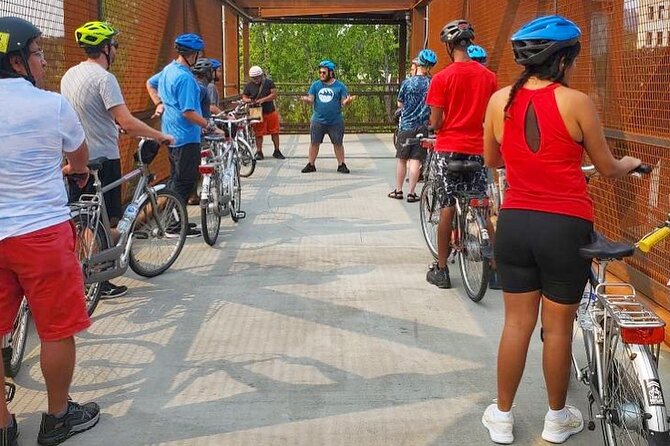
The tour begins at Around Portland Tours, 833 SE Main Street, where you’ll be fitted with a bicycle and helmet. From there, the route heads into inner Southeast Portland and the Hawthorne District before crossing toward the Willamette River.
The group size is described as capped at 15 for a more personal outing, though the activity information also gives a maximum of 20. That means you should expect a small-group experience, but the exact number can vary. Guides have included Kelly, Sara or Sarah, Carrie, Edwin, Angela, and Kathy, depending on the departure.
This matters because the guide does more than point out buildings. The tour depends on stories, timing, and safe group riding. Guides explain city planning, transport, neighborhood changes, public art, and local food stops as you go. The best part is the connection between the places: you see how Portland’s streets, bridges, parks, and river access fit together.
More Cycling Trips in the USA:
- Guided Bike Tour of Old Town Key West
★ 5.0 · 2,611 reviews - NYC: Central Park Bike Rentals
★ 4.2 · 2,528 reviews - Red Rock Canyon eBike Half-Day Tour
★ 5.0 · 1,870 reviews
Ladd’s Addition and the rose gardens
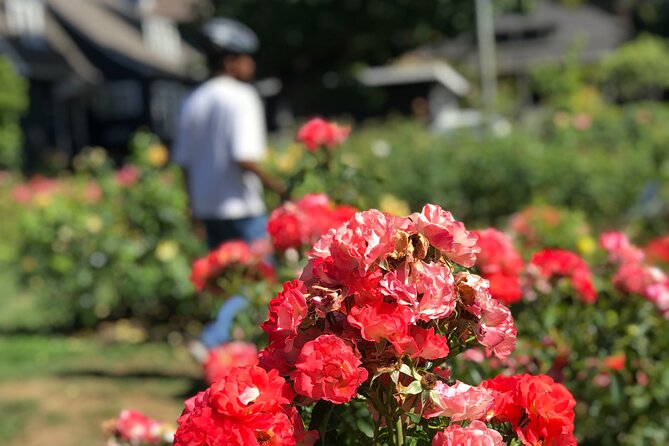
The first major stop is Ladd’s Addition, a planned neighborhood known for its diagonal, almost labyrinth-like street pattern. It feels different from the regular street grid around it, and the design gives the opening part of the ride a clear sense of place.
You’ll stop at one of the neighborhood’s rose gardens for about 10 minutes. This is not a grand formal garden visit. It is a small, pleasant pause that lets you slow down, look closely, and get used to the bicycle.
I like this beginning because it avoids throwing you straight into heavy sightseeing. You start with a quiet residential area, flowers, and an unusual piece of urban design. The rose stop is also good for families and less confident cyclists because the group has a chance to settle into the pace.
Hawthorne, Clinton Street, and Portland’s creative side
The route continues through the Hawthorne area, passing one of Portland’s older food cart pods and one of its newer ones. The point is not simply to eat. You get a quick look at the casual food culture that helped shape the city’s public life.
At Clinton Street Theater, the group pauses near an original streetcar stop and the Clinton Street greenway. If the theater is open, the guide may point out its program of unusual, artistic, and cult films. The stop itself is brief, around five minutes, but it gives you a useful sense of Portland’s independent streak.
This portion of the tour is a good reminder that Portland is not chiefly a city of famous statues and grand civic buildings. Its appeal often comes from the smaller pieces: a neighborhood cinema, a painted wall, a food cart cluster, or a street designed to make cycling easier.
Art along the Orange Line
The ride follows a bike path beside the Orange Line of the MAX light rail. Along the way, you’ll see public art worked into concrete barriers, sidewalks, and walls.
The Solterra Building is connected with a mural by Irish street artist Fin DAC. The tour gives you time to stop and take it in rather than passing it at full speed. Murals can be difficult to appreciate from a moving bicycle, so these short pauses are useful.
The art portion is one of the stronger reasons to choose this tour over a standard city ride. You are not only looking at a set of finished attractions. You are seeing how art is placed into transport corridors and ordinary streets. That tells you something about Portland’s civic priorities and its visual character.
Same roads, a different ride:
- NYC: Central Park Bike Rental
★ 4.1 · 1,651 reviews - Central Park Bike Rental
★ 4.7 · 1,509 reviews - Austin Biker Gang E-Bike Tour
★ 5.0 · 1,399 reviews - Asheville Historic Downtown Guided Electric Bike Tour with Scenic Views
★ 5.0 · 1,234 reviews
Tilikum Crossing, the tour’s big visual moment
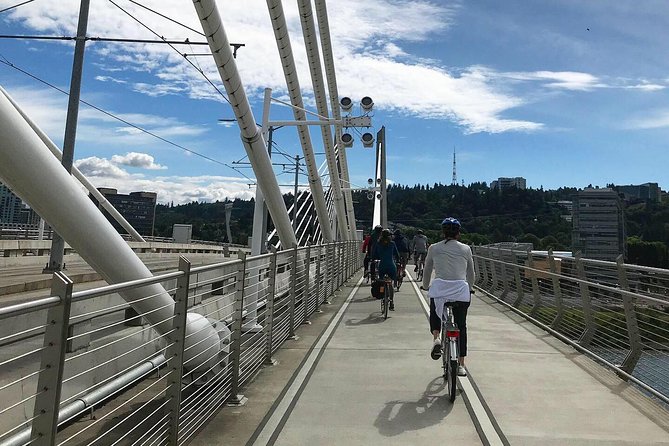
Tilikum Crossing is the route’s signature bridge. It carries bicycles, pedestrians, light rail, and other forms of public transport, but no private cars. The guide takes the slower approach onto the bridge, allowing time for photos, river views, and an explanation of the structure.
A cycling counter records the number of people crossing, so you may be counted as part of the daily and yearly total. It is a small detail, but it fits the tour’s focus on how Portland measures and supports bike travel.
The bridge stop lasts about five minutes, though the actual crossing adds more riding time. The approach includes a climb, and that is one of the few parts that may feel demanding if you are not used to cycling. The route is generally easy, but do not mistake easy for completely effortless.
The reward is a wide view of the Willamette and a close look at one of the city’s most distinctive crossings. I especially like this stop because it combines design, transport, engineering, and scenery without needing a long lecture.
South Waterfront and the aerial tram
After crossing Tilikum Crossing, you’ll ride into South Waterfront and pass the lower terminal of Portland’s aerial tram. The guide explains why the tram was built and what it cost.
This is the kind of detail that gives the ride some bite. Portland’s public projects often raise questions about cost, access, growth, and city planning. You are not simply told that the tram is attractive. You get a little context about why the city built a bullet-shaped vehicle above the riverfront district.
The stop lasts about five minutes. If you want a close look inside the tram or a ride on it, that is not part of this bicycle experience. The tour only passes the terminal.
A pastry, doughnut, or ice cream pause

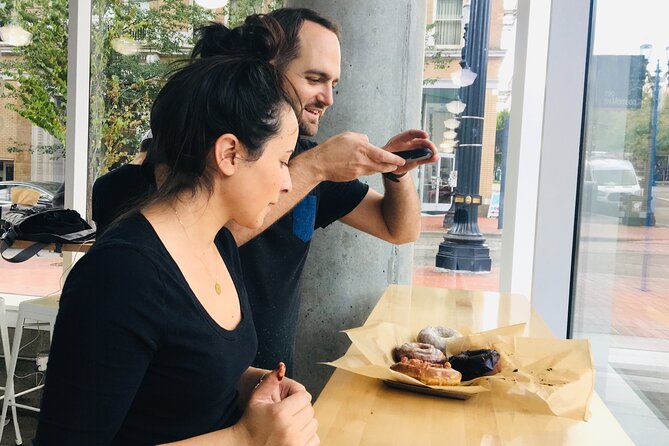
A food stop gives the three-hour ride a welcome break. Blue Star is listed as the usual stop, but it currently operates on limited days and hours. If it is closed, the guide may stop at another doughnut shop, pastry shop, or ice cream place.
The treat is not included, so bring a little extra money. The stop is useful for more than sugar. It gives you time to use a restroom, take a breather, and ask the guide for food or activity suggestions for the rest of your Portland visit.
Past outings have included Blue Star doughnuts, Voodoo Doughnut, Mikiko doughnut holes, and 50 Licks ice cream. Since the exact stop can change, choose this tour for the ride and local orientation, not for one specific shop.
South Waterfront Greenway and Poet’s Beach
The South Waterfront Greenway is one of the quieter sections of the ride. It forms part of Portland’s river access system, with room to pause beside the water and watch the city from a less built-up angle.
Then comes Poet’s Beach, a small sandy stretch created through the Human Access Project. The aim is to reconnect people with the Willamette so they care more about its condition and future.
Poetry written by local students appears along the beach. This is one of the most affecting stops because it puts young local voices beside the river. It is not polished museum material, and that is precisely its appeal. You get a modest public space with an earnest community purpose.
The stop lasts around five minutes. You may want more time, but the tour has a lot of ground to cover. Treat it as a short, thoughtful pause rather than a beach outing.
Riverplace and the changing waterfront
From Poet’s Beach, the route follows the Willamette toward Riverplace. The guide discusses this housing and retail development, which grew from an effort in the 1980s to rethink urban design.
This section helps you read Portland as a city that has changed in layers. The waterfront is not just a pretty edge for photographs. It reflects decisions about housing, shopping, public access, and how people use former industrial spaces.
Riverplace may appeal most to visitors interested in cities and planning. If you want nonstop scenery or historic buildings, this section may feel less dramatic. Its value comes from the explanation and from seeing how a development project fits into the broader riverfront.
Tom McCall Waterfront Park and the Hawthorne Bridge
The ride continues through Tom McCall Waterfront Park. The guide explains what the park used to be and how changes in the early 1970s helped reshape Portland. You’ll hear about the city’s former relationship with its waterfront and the role of Oregon’s governor in changing it.
This is a strong example of the tour’s approach. A park becomes a lesson in public space, political choices, and the way a city decides what belongs beside a river. You are seeing a place locals use, not simply stopping for a postcard.
Near the end, the group rides under the Hawthorne Bridge. The guide explains why this famous structure may rise and fall even when no large ship is visible beneath it. The answer connects to river traffic and the bridge’s working design.
The route then returns to the starting point on SE Main Street. You cover several parts of Portland without spending the entire ride in the downtown core. That gives you a more useful first impression of the city’s neighborhoods and connections.
What the $47 price really includes
At $47 per person, this is a fair price for a three-hour guided city ride. The fee includes the bicycle, helmet, and bottled water, which removes the trouble and cost of arranging basic equipment yourself.
You are also paying for route planning and local interpretation. The tour covers Southeast Portland, Hawthorne, South Waterfront, Riverplace, downtown-adjacent streets, river paths, bridges, public art, and neighborhood spaces. Reaching those places on your own is possible, but you would need to know where to go and how to connect the sections safely.
Food is extra, and gratuities are not included. Bring money for a doughnut, pastry, or ice cream, and tip the guide if the outing earns it. The value is strongest if you are new to Portland, have only a few days, or want a practical introduction before exploring on your own.
Who will enjoy this ride most
This tour suits first-time visitors who want more than a downtown walk. It also works well for families, couples, solo visitors, and locals who know Portland but do not know the best cycling route through it.
The ride is mostly flat and includes frequent stops. That makes it approachable for many people who are not regular cyclists. One family described a teenager who began nervous and finished chatting with the guide, while another family found that teenagers stayed engaged because the ride kept moving and included food and photo stops.
You should still dress for the weather and wear suitable cycling clothes. One experienced rider suggested bike pants and sunglasses, practical advice for three hours outdoors. The tour is conducted in English, and service animals are allowed. Most people can participate, but you should be comfortable riding a bicycle on city streets.
The route can also show Portland’s contrasts. You may pass attractive neighborhoods, active businesses, vacant structures, and areas affected by homelessness. That is part of seeing the city as it is, rather than receiving a polished version built only for sightseeing.
Booking, timing, and cancellation
The activity is usually booked about 16 days ahead, so reserve early if your Portland dates are fixed. Confirmation arrives when you book, and the tour starts and ends at 833 SE Main Street. The meeting point is near public transportation.
Free cancellation applies when you cancel at least 24 hours before the start time. Within 24 hours, you do not receive a refund, and changes are not accepted. The experience also requires a minimum number of participants. If that minimum is not met, you are offered another date or experience, or a full refund.
Should you book the Around Portland bike tour?
Book it if you want a relaxed, useful first look at Portland through neighborhoods, bridges, public art, food culture, and river access. The tour’s strongest features are the patient pace, the practical city context, the Tilikum Crossing ride, and the unexpected stops at Ladd’s Addition and Poet’s Beach.
Skip it if you want a museum-heavy day, a strenuous cycling workout, or a tour built around major landmarks only. Also think twice if rain or cold would make three hours outside unpleasant.
For most visitors, I would book this early in a Portland stay. You’ll leave with a better map of the city, several food and activity ideas, and a clearer sense of where to return on foot or by bicycle.
FAQ
How long does the bike tour last?
The tour lasts approximately three hours.
Where does the tour start and finish?
It starts and ends at Around Portland Tours, 833 SE Main Street, Portland, Oregon 97214.
Are bicycles and helmets included?
Yes. The use of a bicycle and helmet is included in the price.
Is bottled water provided?
Yes, bottled water is included.
What language is the tour offered in?
The tour is offered in English.
How many people can join the tour?
The group is described as capped at 15 for a personal experience, while the activity information lists a maximum of 20 participants.
Is food included?
No. Doughnuts, pastries, ice cream, and other snacks are purchased separately. Blue Star may be visited when open, but another food stop is used when its hours do not work.
Can I cancel for a refund?
You can cancel at least 24 hours before the start time for a full refund. Cancellations or changes made within 24 hours are not refunded or accepted.
New cycling reviews around the USA
- Portland, Maine: Coastal Lighthouses Guided Bicycle Tour★ 4.8 · 23 reviews
- Portland: Food Carts of the Eastside Bike Tour★ 4.9 · 16 reviews
- Essential Portland: 2-Hour Guided Bike Tour★ 4.8 · 43 reviews
- Portland: E-Bike Tour at Multnomah Falls★ 4.8 · 20 reviews
- Pittsburgh: Beauty of the Burgh Bike Tour★ 4.9 · 37 reviews
- NYC: Central Park Guided Electric Bike Tour★ 4.9 · 25 reviews
- Oahu: Kualoa Electric Bike Tour★ 4.6 · 14 reviews
- Oahu: Waikiki E-Bike Ride and Manoa Falls Hike★ 4.9 · 28 reviews
Portland Cycling Tours, compared.

Hike and Bike Tour to Columbia River Gorge Waterfalls
Read our review →
Portland Bicycle Tour with 5 Lighthouses and XL Lobster Roll
Read our review →Browse the lists this ride appears in