
Review · ROME
Appian Way, Catacombs and Aqueducts Park Tour with Top E-Bike
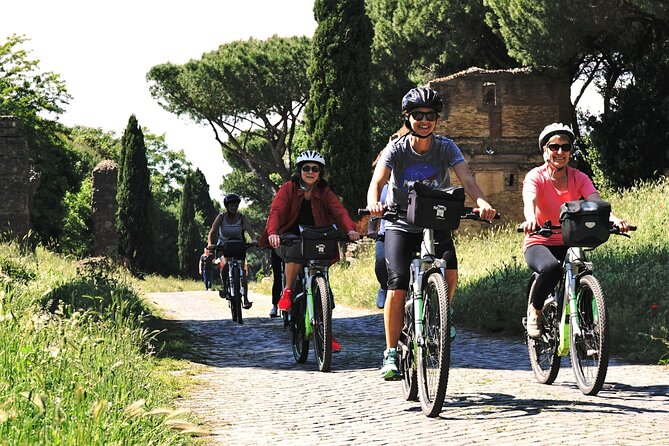
The ancient Appian Way is best understood as a route, not a single sight. On this 27-kilometer e-bike ride, you pass Roman gates, burial chambers, ruined villas, sheep pastures, and enormous aqueducts, reaching places that are awkward to visit on foot. The electric assist saves your legs for the scenery.
I like the way the tour connects two great archaeological parks, and I like the small groups, capped at 10 people. Guides including Claudia, Fabio, Bita, Arina, and Zak have earned praise for clear storytelling and careful pacing. The catch is that this is an intermediate bike ride, with narrow paths, rough ground, and about 40 percent of the route on city streets.
Key points to know before you book
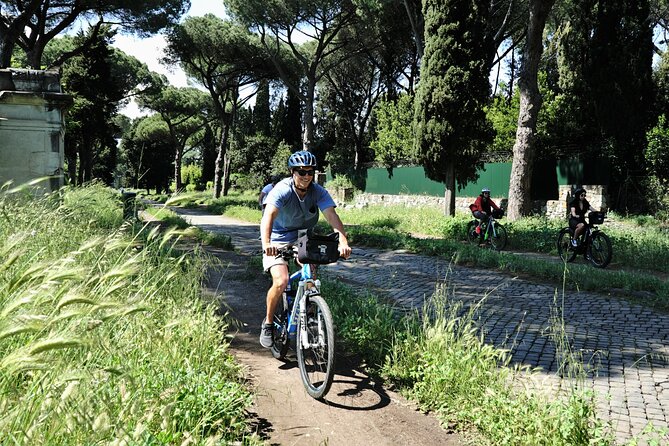
- The e-bike covers a lot of Rome: You ride about 17 miles, with 60 percent of the route off-road.
- The six-hour version earns its extra time: It adds a guided catacomb visit, Villa dei Quintili, Santa Maria Nova, and the Baths of Caracalla.
- You still ride in traffic: About 40 percent of the route uses carefully chosen city streets connecting the two archaeological parks.
- The Appian Way is more than ruins: Expect open fields, ancient paving stones, aqueduct arches, and a quieter side of Rome.
- Small groups help: The maximum is 10 people, so your guide can watch the group and answer questions.
- Bike confidence matters: The route is not recommended if you feel uneasy on a bicycle, and child seats or extensions make it harder.
Why an e-bike is the smart way to see the Appian Way
Rome’s historic center is easy to explore on foot, but the Appian Way and Aqueducts Park are spread across a wide area. Walking between the major sights would take too long, and taxis would remove much of the pleasure of moving through the countryside. The e-bike solves that problem without turning the day into a fitness test.
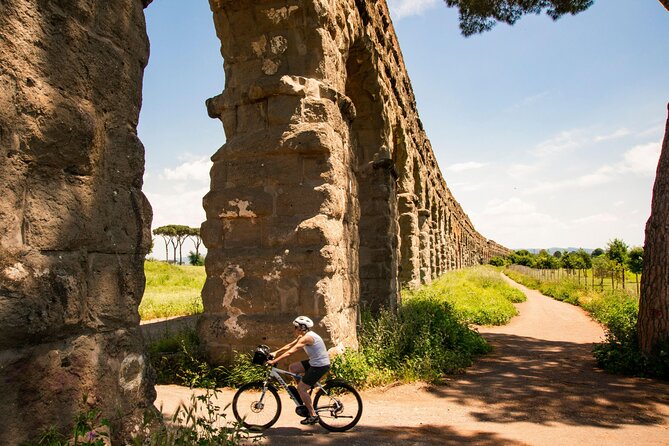
You receive a quality electric bike with puncture-resistant tires, a helmet, a front bag, and a biodegradable water bottle. The motor helps on the longer stretches and uneven ground, though it does not replace basic cycling skill. You still need to steer, brake, balance, and watch the road.
The full route covers about 27 kilometers. Roughly 60 percent takes place away from traffic, on park paths and old roads. The remaining 40 percent uses city streets, some of them narrow. Guides set a careful pace, but you should not expect a fast cycling tour. The point is to ride together, stop for context, and reach ancient sites that are difficult to connect by other means.
Some parts of the ride can be bumpy. If you have back or neck problems, the rough surfaces may be uncomfortable. A helmet is required and provided, and the equipment has a weight limit of 136 kilograms, or 300 pounds.
More E-Bike Tours in Italy
- Rome EBike Tour: Appian Way, Catacombs & Roman Aqueducts
★ 5.0 · 1,766 reviews - Rome: Top Highlights & Hidden Gems Tour by Cannondale E-Bike
★ 4.9 · 1,760 reviews - Rome: Appian Way & Aqueducts E-Bike Tour (Catacombs & Food)
★ 4.9 · 1,498 reviews
Leaving Rome through Porta San Sebastiano
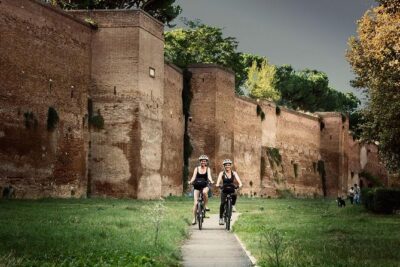
The meeting point is at Via Labicana 49, near public transportation. From there, the ride heads toward Porta San Sebastiano, one of the grand gateways through Rome’s third-century Aurelian Walls.
The stop is brief, about 10 minutes, but it gives you a useful sense of departure. Modern Rome begins to thin out, and the ancient defensive walls frame the transition from the city center to the open archaeological zone. Your guide also uses the early part of the route to explain how the ride will work and help you get comfortable with the bike.
This is not a sightseeing ride where you stop at every corner. You will keep moving, so listen carefully when the guide gives instructions about turns, traffic, and spacing. That matters later, especially on narrow paths.
Riding the ancient Via Appia Antica
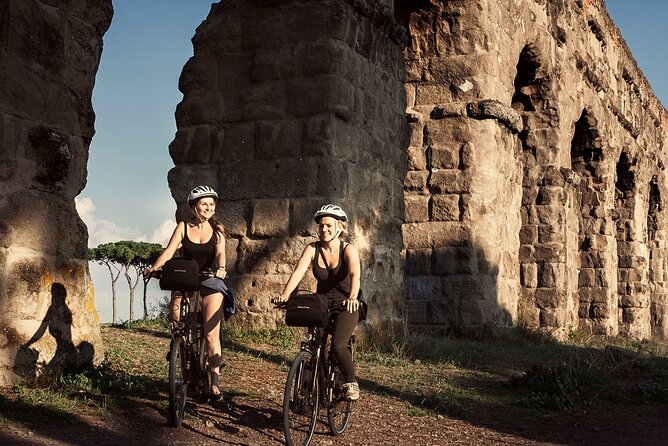
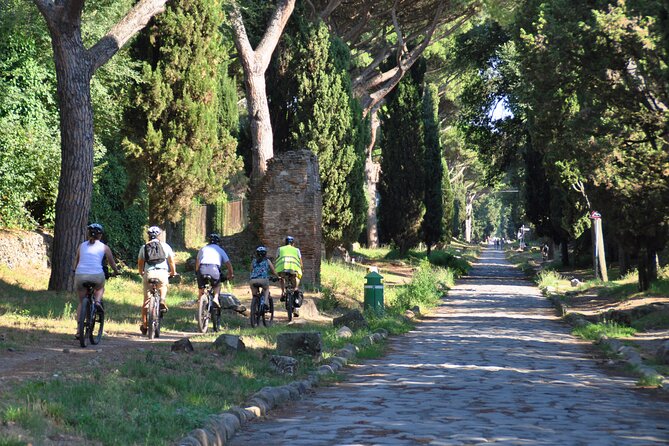
The Appian Way begins almost modestly. Then the modern street gives way to older paving, open ground, trees, and scattered monuments. This is the heart of the experience: you are not simply looking at an ancient road behind a fence. You are moving along its route and seeing how Rome connected its center with the wider empire.
The road was one of antiquity’s great military and trade routes. Here, it survives with an unusual sense of space. The park includes quiet stretches where the city feels far away, even though Rome is close.
You have about 15 minutes listed for this stop, but the Appian Way is part of the ride itself rather than a single timed visit. Expect the guide to pause at selected points rather than deliver one long lecture. The best guides use the road, tombs, and surrounding countryside to explain how Romans traveled, built, buried their dead, and supplied the capital.
On a Sunday, the parks can be busier with local walkers and cyclists. A weekday ride may feel calmer and easier, especially if you are nervous on a bicycle. That is a practical tip worth taking seriously because passing pedestrians and other bikes can make the narrow portions feel more demanding.
Catacombs: choose the six-hour version for the real visit
The catacombs are where the difference between the two tour lengths becomes most important.
On the four-hour route, you make a short pause near the Catacombs of San Callixtus. You can contemplate the site and hear about the vast underground burial complex, associated with roughly half a million burials, but the guided underground visit is not part of that version. On Wednesdays, this stop is not included in the four-hour route.
The six-hour tour includes a 45-minute guided visit to the second-century catacombs. This gives you time to go below ground and understand the burial galleries rather than simply seeing the entrance. Underground spaces can feel tight, so anyone uncomfortable in enclosed places should consider that before booking.
On Wednesdays, the six-hour tour visits the Catacombs of San Sebastiano instead of San Callixtus. The Wednesday route can also run about 30 minutes longer. The same extra half hour applies during the stated January 14 to February 11, 2026 period.
The catacombs are a strong reason to pay for the longer tour, but they also create a timing issue. The guided visit operates on the catacomb site’s schedule, and one account of the experience described a large queue and a crowded underground visit. I would choose the six-hour option for the added history, while accepting that this section may feel less private than the open-air riding.
More E-Bike Tours in Rome
- Rome: Appian Way, Catacombs, & Roman Aqueducts E-bike Tour
★ 4.9 · 1,421 reviews - Rome City Small Group Bike Tour with quality Cannondale EBike
★ 5.0 · 1,380 reviews - Rome by Night – Ebike Small Group Tour – Food and Wine (Option)
★ 5.0 · 1,275 reviews - Rome by Night: E-bike Small Group Tour -Food & Wine (Option)
★ 4.9 · 1,233 reviews
Circus of Maxentius and Cecilia Metella’s tomb
The Circus of Maxentius is part of a fourth-century imperial complex that also included a villa and mausoleum. The stop is short, around five minutes, but the setting helps you picture the scale of Roman entertainment and imperial power.
You then pass the Mausoleum of Cecilia Metella, one of the Appian Way’s best-preserved monuments. This first-century funerary tower was built in memory of a young woman from a patrician family. Its size tells you something about status in ancient Rome. A tomb on this scale was meant to remain visible beside a major road for generations.
Do not expect extended independent exploration at every monument. The tour is designed to cover a large area, so some stops are brief. If your ideal day means entering every ruin and spending half an hour at each one, this ride may feel too quick. If you want a broad view of the Appian Way, the pace makes sense.
Villa dei Quintili on the six-hour route
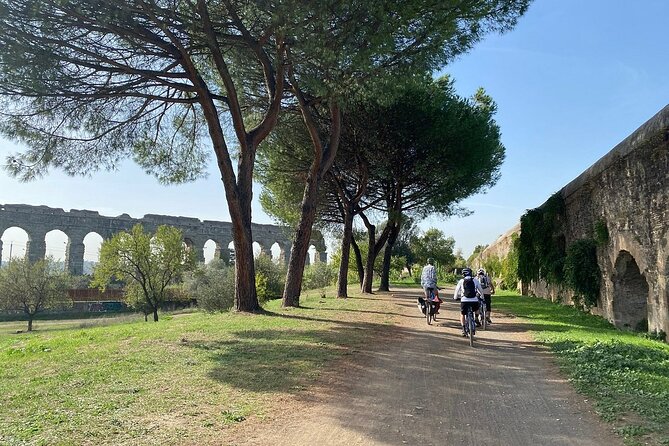
The longer tour adds Villa dei Quintili and Santa Maria Nova. This was a large second-century private estate owned by two wealthy brothers connected with the Roman imperial world.
The villa is valuable because it shows how the elite lived beyond the city’s central monuments. You see the Appian Way not only as a military road or burial route, but also as a place for grand private retreats. The stop itself is listed at about five minutes, so think of it as an introduction from the bike route rather than a full archaeological visit.
That distinction helps when choosing between four and six hours. The extra time gives you more variety and a fuller picture of the area, but it does not turn every stop into a museum-style tour.
Aqueducts Park and Rome’s open countryside
Aqueducts Park is one of the most memorable sections of the ride. Huge arches cross the open parkland, showing how Roman engineers carried water toward the city. Your guide explains the underground channels and elevated sections that formed Rome’s water supply.
The aqueducts are easy to appreciate from a bicycle because you can ride through the open space and see the structures from changing angles. The park also provides a sharp contrast with central Rome. There are broad grassy areas, low hills, valleys, and sheep grazing in the distance.
This is a good place to plan a modest food break if your group and guide allow it. Food and drinks are not included, but the route offers a few places to buy something. Bring water, use the supplied bottle, and do not assume lunch is part of the tour.
The approach to Aqueducts Park involves city riding. That connection is necessary because the Appian Way and aqueducts lie in different parts of Rome’s outer archaeological zone. Your guide chooses routes intended to limit traffic, but no honest description should suggest that the entire day is traffic-free.
Adding the Baths of Caracalla
Only the six-hour route includes the Baths of Caracalla. You see the massive complex from a good vantage point and learn why public baths were central to Roman social life.
The baths were not merely places to wash. They were social, recreational, and civic spaces, and their size reflects the importance Rome placed on public amenities. The view from outside gives you a strong sense of scale without requiring another lengthy indoor visit.
By this point, the six-hour ride has covered a great deal. You may feel tired, especially after the rougher paths, but the e-bike keeps the physical effort reasonable for a person who is comfortable cycling.
What the guide adds to the day
A strong guide makes this tour much better. The most praised guides include Arina, Claudia, Fabio, Bita, Zak, Han, Stefan, Lorenzo, David, Ali, Christian, and Khalid. The consistent strength is not a memorized speech. It is the ability to connect what you see with Roman engineering, burial customs, imperial life, and the practical challenge of guiding a small group through mixed terrain.
Guides also manage the safety side of the experience. They lead through city streets, watch spacing, and set a pace that lets a group stay together. You should still pay attention and avoid treating the ride as a casual stroll. One poor experience involved a pace that felt too slow and tight, while other accounts found the careful group riding reassuring. That difference may come down to your expectations and the exact group on your date.
The maximum group size is 10. That is small enough for direct questions and useful enough for the guide to keep an eye on riders. A minimum of four participants applies, so a tour can be canceled after confirmation if three or fewer people are booked. In that case, you receive an alternative or a full refund.
Four hours or six hours?
Choose the four-hour route if you want a strong introduction to the Appian Way and aqueducts without giving up most of a day. You will see Porta San Sebastiano, the ancient road, the catacomb area, Circus of Maxentius, Cecilia Metella’s tomb, and Aqueducts Park. The catacomb section is a short pause rather than a guided underground tour.
Choose six hours if you have enough time and care about the catacombs. You add the 45-minute guided visit, Villa dei Quintili, Santa Maria Nova, and the Baths of Caracalla. The longer route also gives the day a fuller shape, moving from city walls to ancient road, burial chambers, imperial estates, aqueducts, and baths.
At about $102.79 per person, the tour is not the cheapest way to spend half a day in Rome. The price includes the bike, helmet, water bottle, equipment, and guide, and the ride covers a large area that would be difficult to reach by public transportation alone. The value is strongest for the six-hour option if you would otherwise pay separately for transport and a catacomb visit.
I would not book it simply because an e-bike sounds easy. You need moderate fitness and confidence on a bicycle. Children aged 9 and older can ride an appropriately sized e-bike, while children aged 5 to 8 use a child extension. The operator notes that a child seat or extension makes the intermediate route more difficult.
Practical details that affect your choice
The tour starts and ends at Via Labicana 49. It is offered in English, confirmation arrives at booking, and free cancellation is available up to 24 hours before the start time. Changes or cancellations inside that window are not refundable.
Bring clothing suited to outdoor riding and shoes that work on uneven surfaces. The route offers no included meal, and the open parks can feel exposed to weather. One group encountered rain and still completed the ride, but conditions can change your comfort quickly when you are on a bicycle for four to six hours.
On Easter Sunday, April 5, 2026, the catacombs are closed, so the six-hour tour does not operate. If your visit falls on a Wednesday, allow extra time and check which catacombs are included.
Should you book the Appian Way e-bike tour?
I would book this tour if you want to see a different side of Rome and are comfortable riding a bike in mixed conditions. It is especially good for families with older children, active adults, and anyone who has already seen the Colosseum and Vatican and wants open space, ancient roads, and aqueducts.
I would choose a weekday when possible, and I would pay for the six-hour version if the catacombs matter to you. Skip it if you dislike cycling, have serious back or neck problems, or want a relaxed walking tour with long, unhurried stops.
For the right rider, this is a smart use of half a day or a full morning and afternoon. You cover far more ground than you could on foot, yet the electric assist leaves enough energy to notice the sheep, the ruined villas, the old paving stones, and the great arches carrying water toward Rome.
FAQ
How long is the Appian Way e-bike tour?
You can choose a four-hour or six-hour tour. Wednesday routes may take about 30 minutes longer, and the same extension applies from January 14 to February 11, 2026.
How far do you ride?
The route covers approximately 27 kilometers, or 17 miles. About 60 percent takes place off-road in parks, while about 40 percent uses city streets.
Is the catacomb visit included?
The six-hour tour includes a 45-minute guided catacomb visit. The four-hour tour includes only a short pause near the Catacombs of San Callixtus, and that stop is not included on Wednesdays. On Wednesdays, the six-hour tour visits the Catacombs of San Sebastiano instead.
Is the tour suitable for children?
Children aged 5 to 8 can use a child extension, and children aged 9 and older can ride an appropriately sized e-bike. The route is intermediate, and a child seat or extension makes it more difficult.
Are helmets and bikes provided?
Yes. The tour includes a quality e-bike with puncture-resistant tires, a helmet, a front bag, and a biodegradable water bottle. Helmet use is mandatory.
What happens if the tour does not reach the minimum group size?
A minimum of four participants is required. If the tour is canceled because three or fewer people are booked, you are offered an alternative tour or a full refund.
New cycling reviews around Rome
- Private Rome Bike tour★ 4.5 · 46 reviews
- Rome: Private Half-Day Bike Tour with E-bike★ 5.0 · 24 reviews
- Night Tour of Rome with Top E-bike & optional Italian Dinner★ 4.9 · 108 reviews
- Rome E-Bike Tour: Ultimate Street Food and Market Feast★ 4.9 · 50 reviews
- Rome: Appian Way, Catacombs & Aqueducts by eBike + Transfer★ 4.9 · 421 reviews
- Private Rome City Bike Tour with quality Cannondale EBike★ 5.0 · 176 reviews
- Rome E-Bike Small Group Tour of the Appian Way with Private Option★ 5.0 · 130 reviews
- Rome’s Best by E-bike: Guided City Tour (Small Group or Private)★ 5.0 · 207 reviews
Rome Cycling Tours, compared.
Rome EBike Tour: Appian Way, Catacombs & Roman Aqueducts
Read our review →
Rome: Top Highlights & Hidden Gems Tour by Cannondale E-Bike
Read our review →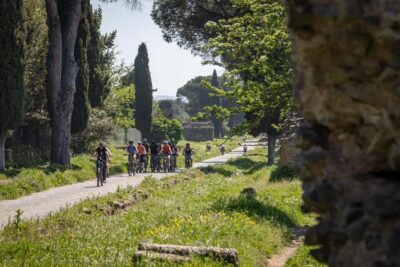
Rome: Appian Way & Aqueducts E-Bike Tour (Catacombs & Food)
Read our review →
Rome City Small Group Bike Tour with quality Cannondale EBike
Read our review →
Rome by Night – Ebike Small Group Tour – Food and Wine (Option)
Read our review →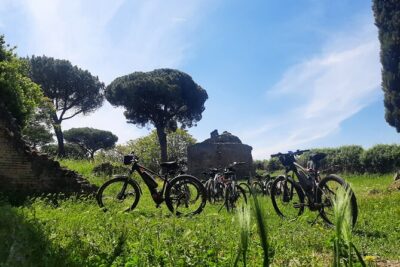
Appian Way Aqueducts Bike Tour (Catacombs & Lunch Option)
Read our review →
Rome: Standard or E-Bike Highlights Guided Tour
Read our review →
Browse the lists this ride appears in