
Review · KYOTO
Kyoto: Full Day Bike Tour
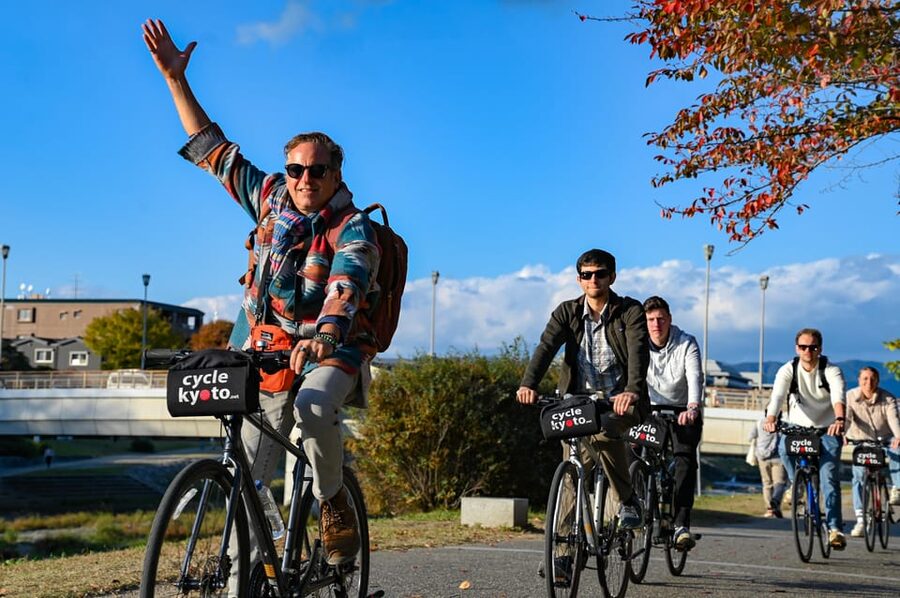
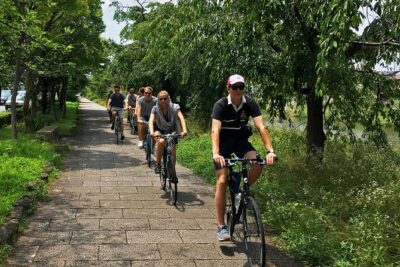
Kyoto’s best surprise may be how much city you can cover on two wheels. This full-day route links major temples and shrines with shopping arcades, river paths, quiet lanes, and the back streets of Gion. You get the famous sights, but you also see the ordinary Kyoto between them.
I like the small group size of nine and the care put into the bikes. I also like the mix of places: Golden Pavilion and Fushimi Inari bring the big visual moments, while local streets, a traditional lunch, and a stop along the Kamo River give the day a more local feel.
The main consideration is stamina. This is a serious full-day outing, lasting 450 minutes, and one outing covered a little over 18 miles. Kyoto is fairly flat, but you still need to be comfortable on a bike and ready for a long day in the saddle.
Key points at a glance
- Nine-hour Kyoto circuit: You visit eight major sights and several city districts in one tightly planned day.
- A useful blend of famous and local: The route moves from Toji and Kinkaku-ji to shopping arcades, neighborhood lanes, Gion, and the Kamo River.
- English-speaking guides: Guides have lived in Japan for considerable time, and named guides such as Jay, Karl, Juan, and Shawn have led past departures.
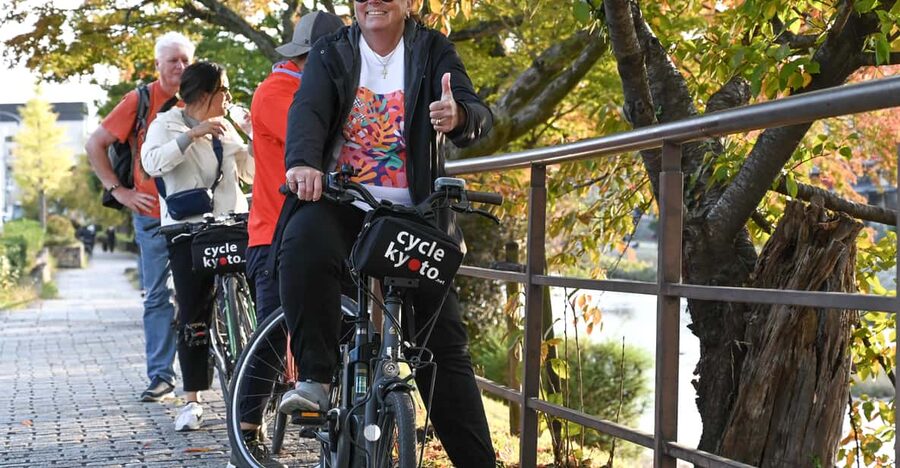
- Comfortable Giant and Trek bikes: Standard cross bikes are well maintained, with e-bikes available if requested.
- Lunch and Golden Pavilion admission included: These extras make the $116 price easier to assess.
- Good for active sightseers: You should be able to ride for most of a day, walk around temple grounds, and manage changing weather.
Why this bike tour works for a one-day Kyoto visit
Kyoto is spread out. Its temples and shrines are not arranged in one easy sightseeing cluster, and public transport can leave you walking between stations, bus stops, and entrance gates. A bike gives you a practical way to connect the dots.
This tour begins at Cycle Kyoto at 9:30 AM. Arrive 15 minutes early for fitting and the safety briefing. The opening 25 minutes at Toji are used for orientation, so you can adjust to the bike, learn the riding routine, and understand how the group will move through the city.
The route then covers the southern, central, northern, and eastern parts of Kyoto. That means you see a lot, but it also means the schedule is full. Stops are planned rather than leisurely. At several temples you will walk the grounds, listen to the guide, and take photographs before getting back on the bike.
I would choose this outing early in a Kyoto visit if you like learning your bearings quickly. Your guide can point out districts and routes that may help with the rest of your stay. Juan, Karl, Jay, and Shawn are among the guides who have led past tours, and the company says its guides speak fluent English and have lived in Japan for a considerable time.
More Full-Day Rides in Kyoto:
- 5 Top Highlights of Kyoto Full Day Bike Tour (E-bike option)
★ 5.0 · 511 reviews - Full Day Biking Tour Exploring the Best of Kyoto
★ 5.0 · 498 reviews - Kyoto: Full-Day City Highlights Bike Tour with Light Lunch
★ 5.0 · 52 reviews
Toji and Nishi Honganji begin the morning
Toji is the first proper stop. It is one of Kyoto’s important Buddhist temples and is described here as the city’s oldest temple. The schedule gives you about 30 minutes to visit after the safety briefing.
That opening stop is useful because it gets you into Kyoto’s religious world before the crowds and long distances of the day take over. The visit is not just a quick photograph from the street. You have time to walk around, hear context, and get a first look at the architecture and grounds.
From Toji, it is about a 10-minute ride to Nishi Honganji. The guided visit lasts roughly 50 minutes, giving this temple more room in the morning schedule. The short ride between the two sites also shows why a bicycle is handy here. You are not waiting for a train or trying to decode a bus route for a journey that takes only a few minutes on two wheels.
The morning continues north through the Sanjo Shopping arcade. This adds a useful change of scene. Kyoto is not only temples and formal gardens. Shopping streets and neighborhood roads show how the city functions day to day, and cycling through them gives you a closer look than a sightseeing coach can provide.
Shinsen-en and Kitano Tenmangu add quieter Kyoto
A quick stop at Shinsen-en gardens breaks up the ride north. It is a smaller, more peaceful pause than the major temple visits, and it helps keep the day from becoming a chain of large tourist sights.
Next comes Kitano Tenmangu Shrine, with about an hour for a guided tour. The shrine is one of the major religious stops on the route, but the appeal of the visit comes partly from the space around it. You can walk the grounds while your guide explains what you are seeing.
The route’s balance is one of its best features. You get large, famous sites, but also places that are easy to miss when you move around Kyoto only by taxi or train. The ride through back streets is not filler. It gives you a sense of how the city’s low-rise neighborhoods connect its headline attractions.
You should still expect some interruptions for traffic, crossings, and group riding. The tour uses generally low-traffic routes where possible, but you need to pay attention and follow the guide. Comfortable cycling matters more than speed.
Kinkaku-ji is the visual high point
Kinkaku-ji, the Golden Pavilion, is the most instantly recognizable stop of the day. Admission is included, and the plan allows about an hour at the site, with approximately 25 minutes described for exploring the pavilion itself.
The pavilion is famous for its gold-covered exterior and its reflection in the pond. The visit is relatively structured because the grounds are designed around a set walking route, but the view is still one of Kyoto’s great visual payoffs.
Admission being included is helpful. You do not have to stop and sort out another ticket after cycling there, and the guide can keep the group moving through a busy attraction. Still, do not expect a long, quiet meditation in front of the pavilion. This is a popular sight, and the stop is one part of a packed day.
After Kinkaku-ji, you ride east toward the Imperial Palace. Lunch comes before or around this section of the route, depending on the day’s flow and restaurant availability. The lunch location may change, so do not plan around a specific restaurant.
More Cycling Trips in Kyoto:
- Hidden Kyoto E-Biking tour
★ 5.0 · 1,843 reviews - Bike Tour Exploring North Kyoto plus Lunch
★ 5.0 · 1,087 reviews - Arashiyama Bamboo Forest & Hidden Gems Bike Tour (Early Bird)
★ 5.0 · 613 reviews - Kyoto: Memory Kyoto E-Bike Tour
★ 4.8 · 297 reviews
A traditional lunch is part of the value
A traditional Japanese lunch is included in the $116 price. That matters on a nine-hour tour. You do not have to spend time searching for food in an unfamiliar part of the city, and the planned break gives you time to rest, eat, and reset before the afternoon riding.
The food details are not fixed. Past outings have included a ramen meal with a special duck broth, and guides have also taken groups to good food spots and ice cream. Treat those details as examples rather than promises, since the lunch location depends on availability.
I see the meal as both a practical and financial advantage. Kyoto meals can vary widely in price, and having lunch included makes it easier to compare this tour with a cheaper bike rental. A rental may cost less upfront, but it will not give you a guide, a planned route, temple context, or a reserved lunch stop.
The Imperial Palace and Kamo River slow the pace
The Kyoto Imperial Palace gets about an hour. After several temple and shrine visits, this is a welcome change in scale. The grounds offer broad open spaces and a different view of the city’s former political center.
You will have time to walk rather than simply stop for a photograph. The guide can add context about the palace and Kyoto’s role as Japan’s imperial capital, though the exact depth of explanation will depend on the guide and the questions you ask.
From there, the route picks up the Kamo River and heads south. The planned photo stop lasts about 40 minutes. This is one of the more relaxed parts of the day, with a chance to pause beside the water and take in the city at a slower pace.
That pause is important because the itinerary is active. A full day of riding and temple visits can become tiring, even on flat streets. Use the river stop to drink water, adjust clothing, and check that your bike still feels comfortable.
Gion by bicycle, then on to Tofukuji
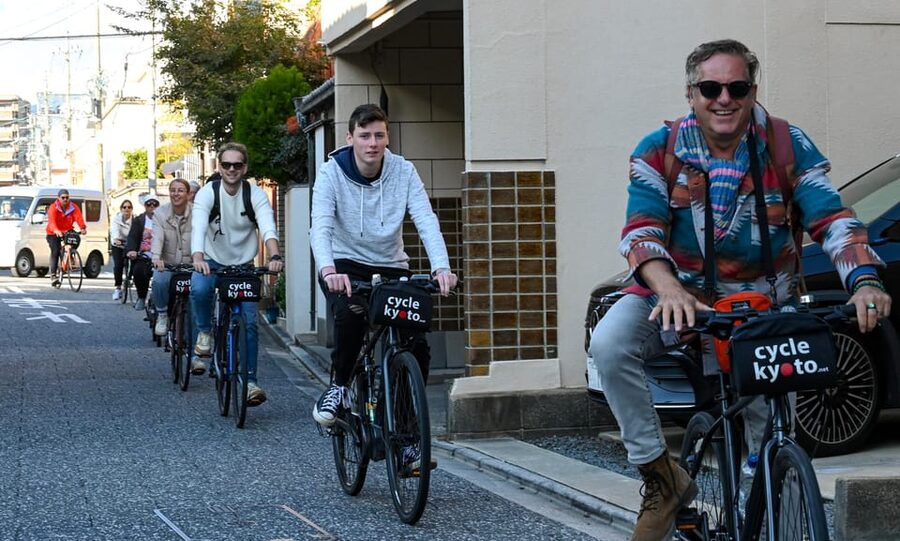
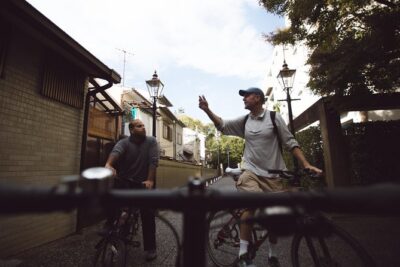
The route enters Gion from the north and heads through the back streets of Kyoto’s famous geisha district. The tour does not promise a staged performance or a guaranteed geisha sighting, but the district itself is a memorable part of Kyoto. Its traditional buildings and narrow lanes provide a sharp contrast with the shopping arcades and wider city roads earlier in the day.
Cycling through Gion requires care. You should ride at the guide’s pace, respect pedestrians, and expect to dismount or slow down in tighter areas. The point is not to race through the district. It is to see how the older streets fit into the modern city.
The route then continues south to Tofukuji Temple for a 30-minute photo stop. This is a shorter visit than Nishi Honganji or Kitano Tenmangu, but it gives the day another architectural and religious landmark before the final major stop.
By this stage, the length of the tour becomes clear. You have already crossed much of Kyoto and visited a long list of major sites. If you are not used to long bike rides, this is where the e-bike option may become especially useful.
Fushimi Inari supplies the final big image
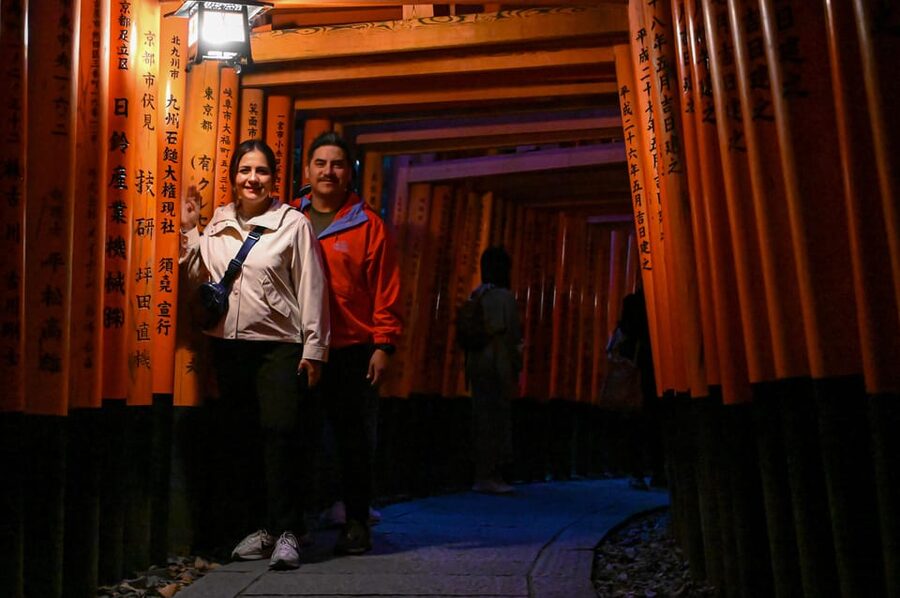
The last major stop is Fushimi Inari Taisha, reached through its famous Senbontorii, or thousands of red torii gates. The guided visit is scheduled for about an hour.
The torii-lined approach is one of Kyoto’s most famous sights, and it makes a strong finish to the route. You can walk among the gates and see the shrine area without trying to fit the entire mountain trail into an already long day.
Do not assume the one-hour stop means you will hike all the way to the summit. The supplied schedule specifically centers on the Senbontorii area, and the tour then returns to Cycle Kyoto. Comfortable shoes matter here because the final stop is on foot, not simply a quick view from the bike.
After Fushimi Inari, you cycle back to the shop. The day ends where it began, which makes it simpler to collect any larger luggage you left in the secure shop space.
Bikes, distance, and physical demands
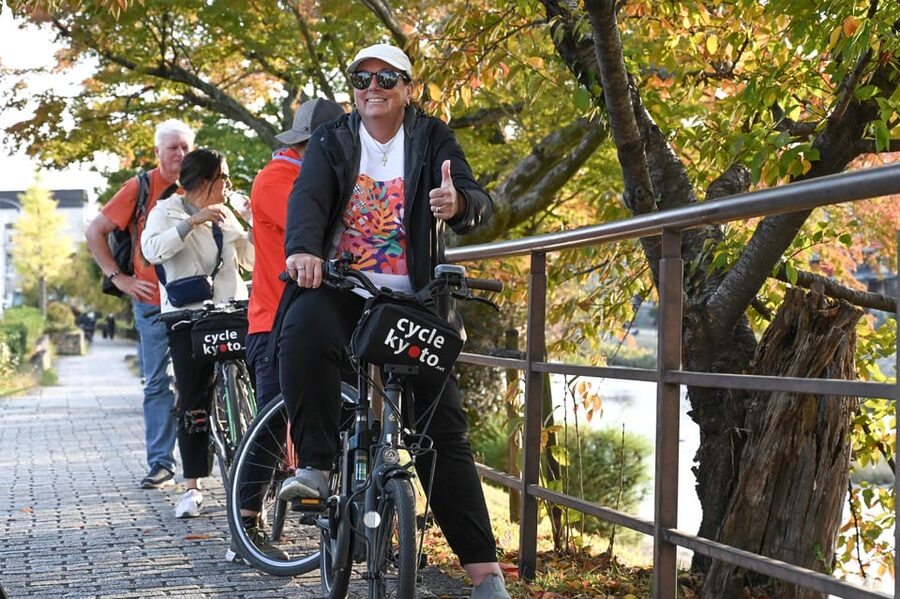
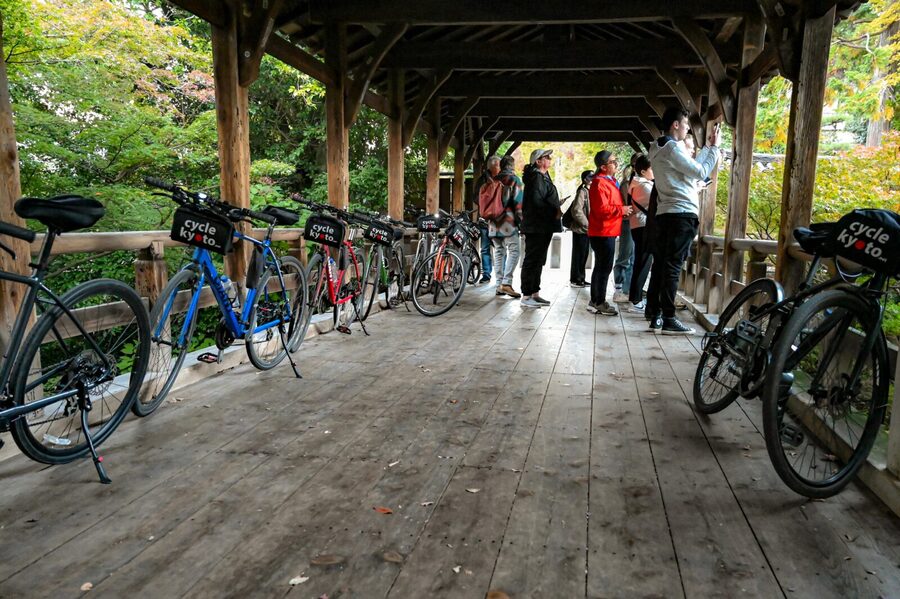
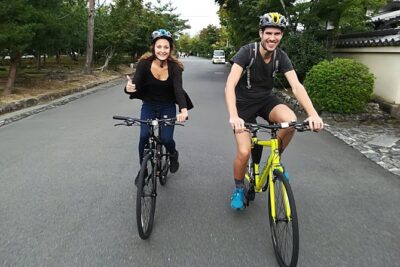
Cycle Kyoto uses well-maintained cross bikes from Giant and Trek. These are a sensible choice for city riding, offering more comfort and stability than a basic city bicycle while remaining efficient on paved roads.
E-bikes are available upon request. Ask for one when booking or before the day begins, rather than assuming one will be waiting. The route is generally flat, and one rider found a standard bike easy to manage, but flat does not mean effortless when you are riding and walking for most of nine hours.
One outing covered a little over 18 miles, or roughly 29 kilometers. The exact distance may vary, but that figure gives you a useful idea of the commitment. You should be comfortable cycling in city conditions, stopping often, starting again, and walking around temple grounds.
The tour is not suitable for children under 12, pregnant women, or anyone who cannot ride a bike. It is also not a good choice if you want a slow day with long café breaks. Bring water, sunscreen, a hat, comfortable shoes, and clothing suited to cycling. High heels are not allowed, and smoking is not allowed.
Is $116 a fair price?
At $116 per person, this is not the cheapest way to see Kyoto. The price includes the bike, helmet, English-speaking guide, Golden Pavilion entrance, and traditional Japanese lunch. Those inclusions make the cost reasonable if you would otherwise pay separately for transport, admission, food, and a guided visit.
The bigger value is time. You can connect Toji, Nishi Honganji, Kitano Tenmangu, Kinkaku-ji, the Imperial Palace, Gion, Tofukuji, and Fushimi Inari without arranging several separate journeys. You also get help with the less obvious links between those places.
I would compare it with the cost of renting a bike for a day, paying for Kinkaku-ji, buying lunch, and finding your own route. If you are comfortable navigating Kyoto and prefer to stop whenever you like, independent cycling may suit you better. If you want a well-organized cultural route with local context, the included services make the price easier to justify.
Free cancellation is available up to 24 hours before the start, and you can reserve now and pay later. The tour does not run in all weather conditions. Heavy rain can lead to cancellation and a refund, so check the forecast and dress sensibly.
Should you book the full-day Kyoto bike tour?
Book it if you are short on time, physically active, and eager to see both headline sights and ordinary neighborhoods. It is especially useful early in a Kyoto stay, when a guide can help you understand the city’s layout and suggest places to visit later.
You should skip it if you want a slow temple day, dislike cycling in city traffic, or are unsure about riding for up to 18 miles. The route is packed, but that is also its purpose. For the right rider, $116 buys a full day of movement, context, food, admissions, and a much broader look at Kyoto than a single temple visit can provide.
FAQ
Where does the Kyoto bike tour start?
The tour starts at Cycle Kyoto.
What time should I arrive?
The tour starts at 9:30 AM sharp. Arrive 15 minutes early for bike fitting and preparation.
How long does the tour last?
The stated duration is 450 minutes, or about seven and a half hours, although the described schedule is presented as a full-day experience. Check the available start time when booking.
What language is the tour in?
The live tour guide speaks English.
How large is the group?
The group is limited to nine participants.
What kind of bikes are provided?
The company provides well-maintained cross bikes made by Giant and Trek.
Are e-bikes available?
Yes. E-bikes are available upon request.
Is lunch included?
Yes. A traditional Japanese lunch is included, although the restaurant may vary depending on availability.
Is entry to the Golden Pavilion included?
Yes. The entrance fee to Kinkaku-ji, also called the Golden Pavilion, is included.
Who should not join this tour?
The tour is not suitable for children under 12, pregnant women, or people who cannot ride a bike.
New cycling reviews around Kyoto
- Best of Kyoto: Ginkakuji & Path of Philosophy E-Bike Tour★ 4.9 · 79 reviews
- Kyoto: Tailored E-Bike Tour to Highlights & Hidden Gems★ 4.9 · 32 reviews
- Kyoto: Full-Day City Highlights Bike Tour with Light Lunch★ 5.0 · 52 reviews
- Kyoto: Half-day Guided Bike Tour with Fushimi Inari★ 4.9 · 21 reviews
- Kyoto: Early Bird E-Bike Tour with Lunch★ 5.0 · 14 reviews
- Cycle Kyoto’s Hidden Gems & Gion Stroll★ 5.0 · 29 reviews
- Kyoto: Arashiyama Bamboo Forest Morning Tour by Bike★ 5.0 · 115 reviews
- Kyoto: Afternoon Bamboo Forest and Monkey Park Bike Tour★ 4.9 · 83 reviews
Kyoto Cycling Tours, compared.
Arashiyama Bamboo Forest & Hidden Gems Bike Tour (Early Bird)
Read our review →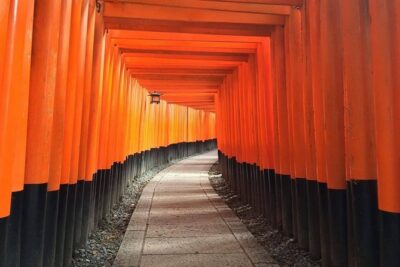
5 Top Highlights of Kyoto Full Day Bike Tour (E-bike option)
Read our review →
Full Day Biking Tour Exploring the Best of Kyoto
Read our review →
Browse the lists this ride appears in