
Review · KYOTO
E-Bike Tours of the highlights of Kyoto!!!
Kyoto makes you work for its best sights. The city’s temples sit far apart, buses fill quickly, and narrow lanes can turn a simple outing into a map-reading chore. This small-group e-bike tour solves much of that by linking famous places with quiet streets, river paths, and old neighborhoods. Guides such as Philippe, Kevin, and Niall add useful context about religion, architecture, and daily life.
I especially like two things: the chance to see backstreets and local neighborhoods between major sights, and the included e-bike, which takes the strain out of Kyoto’s long distances. The main consideration is stamina. Even with electric assistance, you may spend several hours riding, walking, and standing, and the exact sights depend on the east or west course.
Key points at a glance
- Two distinct routes: The east course covers Heian Shrine, Ginkakuji, and the Philosopher’s Walk, while the west course visits Kinkakuji, Ryoanji, and Arashiyama Bamboo Forest.
- E-bikes are included: Electric assistance helps on a long day of cycling, though you still need a moderate level of fitness.
- Small groups: The tour is capped at eight people, allowing the guide to answer questions and adjust the pace more easily.
- More than temple hopping: You ride through Gion, along waterways, and through residential streets where Kyoto life feels less staged.
- Strong guide element: Philippe, Kevin, and Niall are praised for clear explanations, local stories, and friendly help.
- Lunch is your responsibility: A picnic stop may be arranged with the group, but food is not included in the price.
Why an e-bike makes sense in Kyoto
At about $109.43 per person, this is not the cheapest way to see Kyoto. It is a useful purchase if you want several major sights connected in one outing without relying on crowded buses, taxis, or your own navigation skills.
The electric motor matters most because the tour lasts roughly five and a half hours, though the stated duration can range from 3.5 to 6 hours. You are not pedaling nonstop. The day is broken into riding sections, temple visits, garden walks, photo stops, and time for explanations. Still, the distance adds up.
Most of the route is described as fairly flat, and the e-bike makes ordinary city riding much easier. You should not confuse that with a passive sightseeing ride. You will handle a bicycle in city traffic, stop and start often, and walk through temple grounds. One unfavorable experience raised concerns about bicycle quality and crowded streets, so I would pay attention during the bike fitting and ask questions before setting off.
The tour is best for adults and older teenagers who already feel comfortable on a bicycle. A moderate physical fitness level is required. The electric motor helps, but it does not replace balance, awareness, or the ability to ride for several hours.
More City Highlights Bike Tours in Japan
- 5 Top Highlights of Kyoto Full Day Bike Tour (E-bike option)
★ 5.0 · 511 reviews - Kyoto: Full-Day City Highlights Bike Tour with Light Lunch
★ 5.0 · 52 reviews - Kyoto: Tailored E-Bike Tour to Highlights & Hidden Gems
★ 4.9 · 32 reviews
Choosing between Kyoto’s east and west courses
The course choice is the most important booking detail. The two routes are not interchangeable, and the main stop list can be confusing if you do not check which side of Kyoto you are selecting.
The east-side course includes Heian Shrine, Ginkakuji Temple, and the Philosopher’s Walk. It also passes through traditional neighborhoods and is especially appealing if you want gardens, quieter lanes, and a calmer pace.
The west-side course includes Kinkakuji, Ryoanji, and Arashiyama Bamboo Forest. It packs in three famous sights, including the Golden Pavilion and one of Japan’s best-known rock gardens. It may feel more like a classic first-time Kyoto sightseeing route.
You may also pass through Gion or along the Kamo River, depending on the route and conditions. Guides have adjusted rides around festivals, road closures, and heavy crowds, so the precise path can change. That flexibility is useful, but it also means you should not assume every Kyoto landmark appears on every departure.
Heian Shrine and its quiet garden
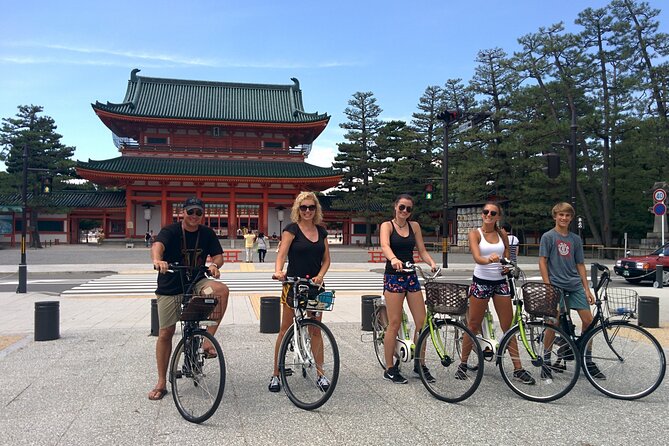
On the east course, Heian Shrine gives you a grand opening. The shrine recreates elements of Kyoto’s former imperial capital, with large gates and a broad ceremonial setting. The more rewarding part for many visitors is the garden behind the main shrine area.
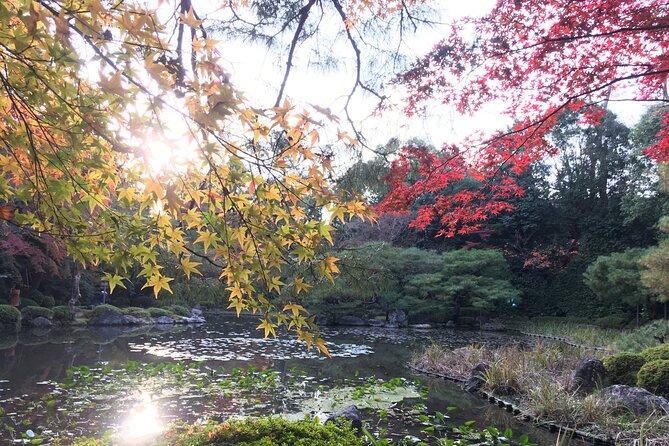
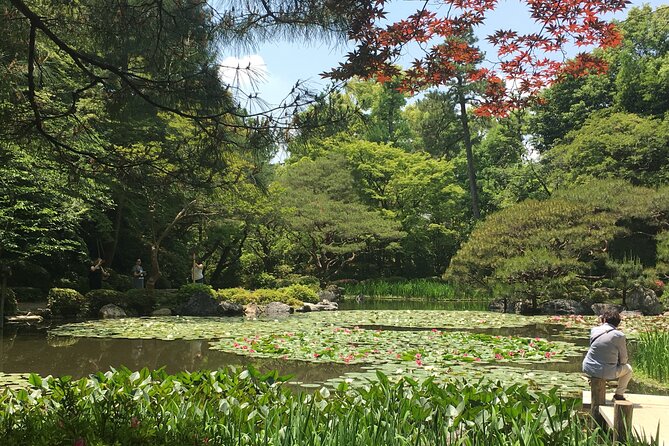
The garden contains three large ponds and plenty of plant life. It gives you room to slow down after the ride and consider how Japanese garden design uses water, bridges, plants, and carefully framed views. The admission fee is included, so you do not have to make a separate decision at the entrance.
Allow about an hour here. That is enough time to hear the guide’s explanation, walk through the garden, and take photographs without reducing the stop to a quick look. If you prefer active sightseeing to long museum visits, this is a good use of time.
Ginkakuji and the art of restraint
Ginkakuji, often called the Silver Pavilion, is known less for a shiny exterior than for its gardens. The grounds are a fine place to see the controlled simplicity of Zen garden design, with gravel, rocks, trees, and paths arranged to shape your view.
The tour allows about an hour, including admission. A guide can help you notice details that are easy to miss when you walk through on your own. Japanese religious sites can seem quiet and spare at first glance, but the placement of a stone, the curve of a path, or a view across a garden often carries the visual meaning.
This stop is a good match for you if you enjoy design, gardens, and cultural explanation. It may be less satisfying if your priority is only grand buildings or dramatic interiors. Much of Ginkakuji’s appeal is in the grounds and the way they make you look.
More E-Bike Tours in Japan
- Hidden Kyoto E-Biking tour
★ 5.0 · 1,843 reviews - Kyoto: Memory Kyoto E-Bike Tour
★ 4.8 · 297 reviews - Kyoto: City Secrets eBike Tour
★ 4.9 · 196 reviews - Kyoto: Hidden Gems E-Bike Tour with Local Japanese Guide
★ 4.9 · 189 reviews
The Philosopher’s Walk by bicycle
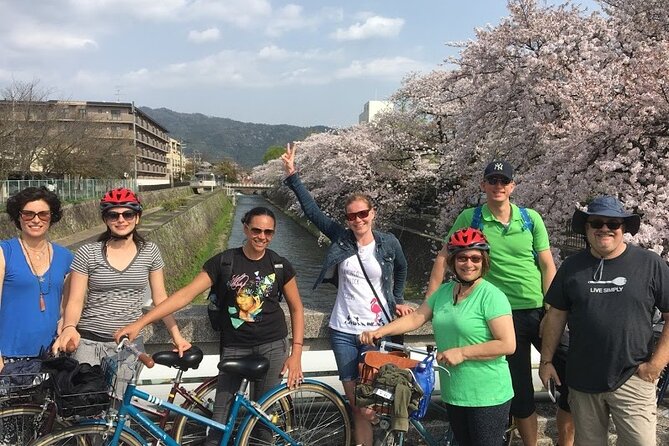
The Philosopher’s Walk is one of the east course’s nicest transitions. The path follows a canal through trees and residential surroundings, giving you a pleasant change from ordinary roads. The ride is about 40 minutes, and admission is free.
This section illustrates the strength of the tour. You are not simply being taken from one ticketed sight to another. You are moving through Kyoto at street level, with time to notice houses, small shops, waterways, and the way people use their neighborhoods.
The path can attract visitors, especially during popular seasons, but it still offers a welcome change of pace. The route is one of the most frequently praised parts of the east course, particularly for its mix of nature and easy cycling. A picnic may be arranged nearby if the group chooses to buy food, but lunch itself is not included.
Kinkakuji, Kyoto’s Golden Pavilion
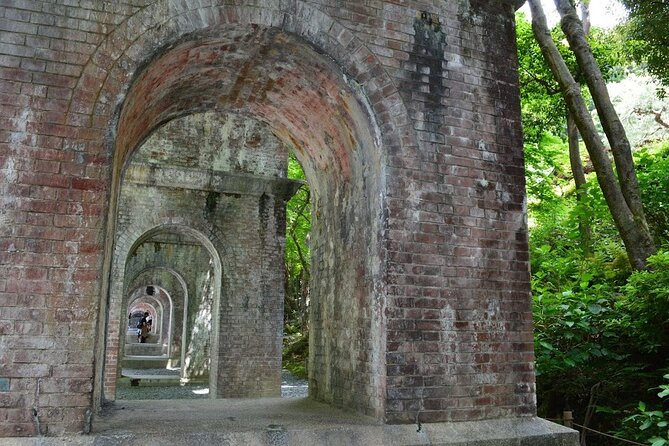
The west course visits Kinkakuji, the Golden Pavilion, for about 45 minutes. The upper levels are covered in real gold leaf, and the building reflects across the pond in the classic view you have likely seen in photographs.
This is one of Kyoto’s headline sights, so expect it to feel more popular than the quieter parts of the ride. The advantage of arriving with a guide is that you can get the basic story and visual context without spending time figuring out the route or ticket process. Admission is included.
The stop is short by design. You will see the pavilion, walk through the grounds, and hear the guide’s explanation, but this is not a slow, empty-garden experience. If the Golden Pavilion is high on your list, the west course gives you a practical way to combine it with two other major sites.
Arashiyama Bamboo Forest
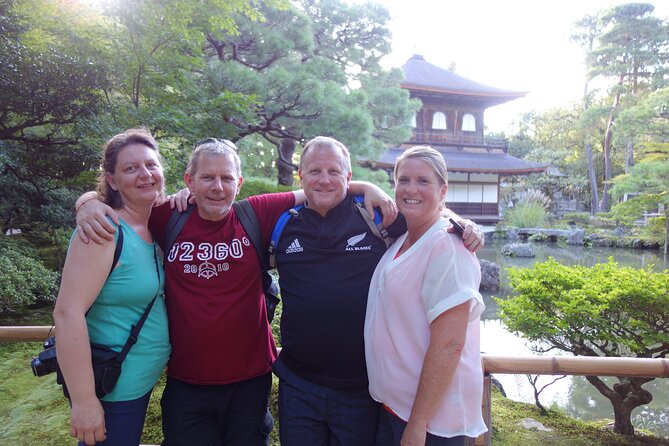
The Arashiyama Bamboo Forest is given about 30 minutes. Tall bamboo creates a striking corridor, and the setting feels unlike the open temple gardens on the rest of the route.
The short time is both a strength and a limitation. It lets you see this famous sight without allowing one stop to swallow the day, but you should not expect a long walk through every part of Arashiyama. The grove can be crowded, and the experience depends greatly on the time and conditions of the visit.
The bicycle helps you reach the area as part of a larger day, but the stop itself is on foot. Keep your bike handling and walking shoes in mind when choosing clothing. You will want something comfortable for repeated transitions between riding and sightseeing.
Ryoanji and its famous rock garden
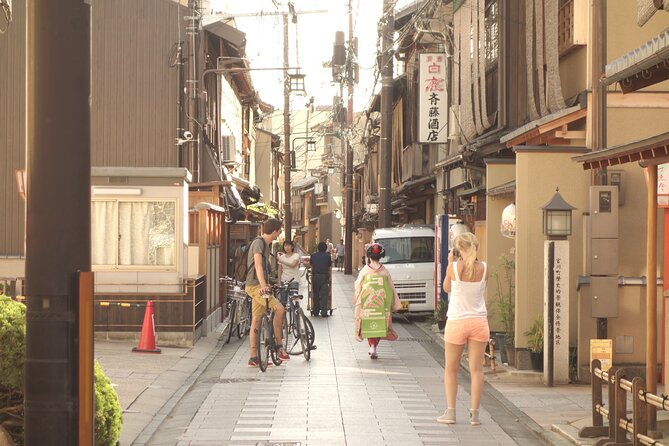
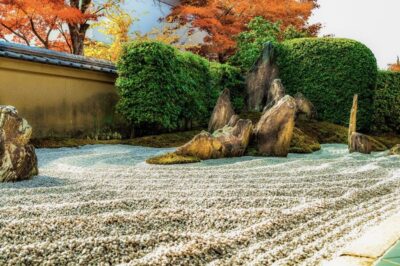
Ryoanji receives about 40 minutes on the west course. Its rock garden is one of the best-known examples of Japanese dry garden design, using stones and carefully raked gravel rather than ponds or elaborate planting.
The garden invites quiet attention. You may find yourself looking at the arrangement from several angles, wondering how the composition changes as you move. Your guide can explain the symbolism and the way the site fits into Japanese religious practice, which adds meaning to what might otherwise be a brief photo stop.
The visit also balances the more visually obvious Golden Pavilion and bamboo grove. Kinkakuji gives you shine, Arashiyama gives you height and natural texture, and Ryoanji gives you restraint. Together, they make the west route varied rather than repetitive.
The best part may be between the landmarks
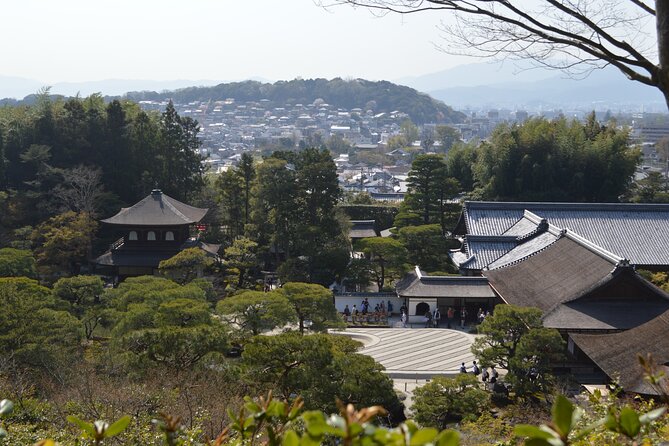
The official sights are important, but I would not book this tour only for the admission-ticket stops. The strongest feature is the movement between them.
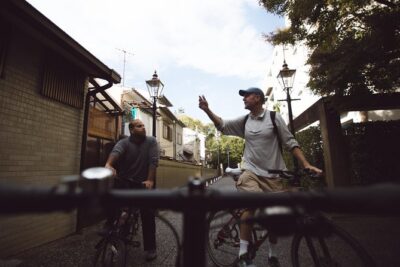
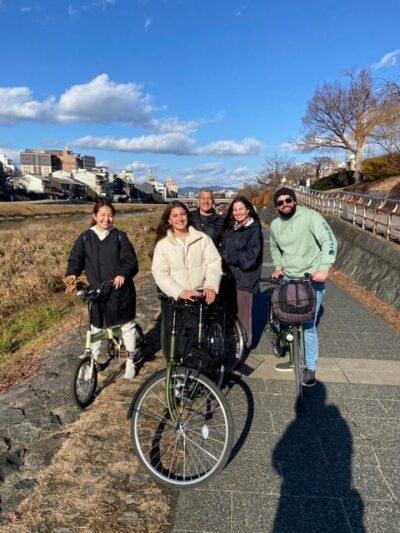
Guides have taken groups through smaller streets, along the Kamo River, and through parts of Gion where traditional houses and geisha districts offer a different view of Kyoto. You may see ordinary homes, shops, side lanes, and changing neighborhood architecture. These stretches help explain how temples and shrines fit into a living city rather than existing as isolated attractions.
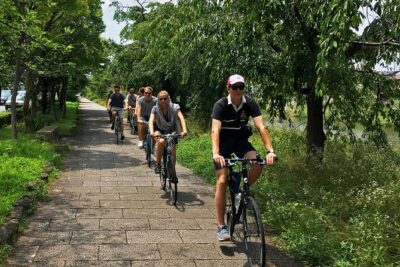
The ride also gives you a closer sense of distance. On foot, Kyoto’s major sights can feel scattered. From a bicycle, the city connects more naturally. You notice how quickly a busy road can give way to a quiet lane, or how a river path offers relief from traffic.
This is where guides such as Philippe and Kevin have made a real difference. Philippe is praised for combining history with artistic observation and for finding quieter routes. Kevin is known for explaining Japanese religion, traditions, and everyday life in a friendly, conversational way. Niall has also led rides focused on local neighborhoods, temples, and riverside routes. The exact guide is not guaranteed, but the tour clearly depends on strong storytelling as much as on the bicycle.
What the day feels like in practice
Expect a rhythm of ride, stop, walk, listen, and ride again. That makes the experience less physically relentless than a five-hour cycling race, but you still need energy for a full half-day or more.
The group size is limited to eight people. That is small enough for the guide to stop for photographs, answer questions, and keep an eye on the group. It is not a private tour, so the pace and lunch choices may require some compromise.
Lunch is not part of the price. In some groups, the guide has helped arrange a picnic using prepared food from a local grocery store. That can be a pleasant, informal break and a chance to choose what you want to eat. Treat it as a possible group arrangement, not an included feature.
The meeting point is Kyoto Fun E-Bike Tours & Rentals at 222-2 Koyamacho, Kita Ward. The activity ends back there. It is near public transportation, which makes the start and finish easier to manage, but you should allow enough time to reach the shop before departure.
Price, value, and practical drawbacks
The $109.43 price includes the guide, e-bike rental, landing and facility fees, and admission to the listed paid sites. Lunch is extra.
I think the price is reasonable if you want a guided introduction to Kyoto and would otherwise pay for several admissions, local transport, and perhaps a taxi between distant areas. It is less compelling if you are happy to use public transit, spend a full day at one temple district, or rent a bicycle on your own.
The tour’s 99 percent recommendation rate and 4.9 rating from 292 reviews point to consistently strong delivery, especially from the guides. The most repeated strengths are the friendly instruction, the information about Japanese culture, the comfortable bikes, the side streets, and the relaxed balance between riding and walking.
The drawbacks are clear too. Crowded roads can make cycling stressful, especially if you are not used to urban riding. One complaint focused on bicycle quality, so inspect your bike before leaving. The east and west courses cover different sights, and a booking mistake could leave you expecting the wrong temples. Finally, the weather matters. The tour can be canceled in poor conditions, with a different date or full refund offered.
You can cancel for a full refund up to 24 hours before the start time. Changes made inside that window are not accepted, and the experience also requires a minimum number of participants.
Who should book this Kyoto ride?
I would choose this tour if you have limited time in Kyoto and want a guided introduction that mixes famous sights with ordinary streets. It is especially suitable for couples, friends, and families with older teenagers who are comfortable on bikes.
It also works well after a crowded day of sightseeing. The electric bicycle and backstreet routing give you a different view of Kyoto, and the guides add the cultural explanation that you may miss when rushing between temples alone.
I would hesitate if you dislike cycling in traffic, have difficulty walking for several hours, or want complete control over every stop. This is a group outing with a planned route, not a private chauffeur service. Check the east or west course carefully, choose the route that matches your priorities, and arrive ready to ride.
Should you book it?
Book it if you want to cover ground while still seeing Kyoto at street level. The east course is the better fit for gardens, the Philosopher’s Walk, quieter areas, and a slower visual rhythm. The west course is the stronger choice for first-time highlights such as Kinkakuji, Ryoanji, and Arashiyama.
The tour’s real value lies in the combination of electric-assist cycling, thoughtful routing, and strong local guides. It does require effort, and the city streets are not always easy. But if you are comfortable on a bike, this is a smart way to connect Kyoto’s major sights with the neighborhoods and everyday scenes between them.
FAQ
How long does the Kyoto e-bike tour last?
The experience lasts approximately 3.5 to 6 hours, with the usual tour duration described as about 5.5 hours.
What sights are included on the east-side course?
The east-side course includes Heian Shrine, Ginkakuji Temple, and the Philosopher’s Walk.
What sights are included on the west-side course?
The west-side course includes Kinkakuji Temple, Arashiyama Bamboo Forest, and Ryoanji Temple.
Is the bicycle rental included?
Yes. An e-bike rental is included in the tour price.
Is lunch included?
No. Lunch is not included. A group may choose to buy food for a picnic, but you pay for your own meal.
How many people can join the tour?
The activity has a maximum of eight travelers.
Where does the tour begin?
It starts at Kyoto Fun E-Bike Tours & Rentals, 222-2 Koyamacho, Kita Ward, Kyoto, 603-8152, Japan.
Where does the tour end?
The tour ends back at the meeting point.
What level of fitness is required?
A moderate physical fitness level is required. You will cycle, walk through temple grounds, and spend several hours outdoors.
What happens if the weather is poor?
If poor weather causes cancellation, you will be offered a different date or a full refund. You can also receive a full refund if you cancel at least 24 hours before the start time.
More City Highlights Bike Tours in Kyoto
- 4.5-hr Kyoto Historical Highlights Bike Tour with UNESCO
★ 4.7 · 13 reviews - 3-Hour Porto Highlights on a Electric Bike Guided Tour
★ 5.0 · 4,392 reviews - Porto: City Highlights 3-Hour Guided Electric Bike Tour
★ 4.8 · 3,092 reviews - Highlights & Hidden Spots of Barcelona Bike Tour w/ Local Guide
★ 4.5 · 3,009 reviews
More E-Bike Tours in Kyoto
- Historical Kyoto E-Bike Tour
★ 5.0 · 181 reviews - Best of Kyoto: Ginkakuji & Path of Philosophy E-Bike Tour
★ 4.9 · 79 reviews - Kyoto: Fushimi Inari Shrine and Tofukuji Temple E-Bike Tour
★ 5.0 · 75 reviews - Kyoto: Hidden Gems E-Bike Tour Through Backstreets & Temples
★ 4.9 · 54 reviews
New cycling reviews around Kyoto
- Best of Kyoto: Ginkakuji & Path of Philosophy E-Bike Tour★ 4.9 · 79 reviews
- Kyoto: Tailored E-Bike Tour to Highlights & Hidden Gems★ 4.9 · 32 reviews
- Kyoto: Half-day Guided Bike Tour with Fushimi Inari★ 4.9 · 21 reviews
- Kyoto: Full-Day City Highlights Bike Tour with Light Lunch★ 5.0 · 52 reviews
- Kyoto: Full Day Bike Tour★ 4.9 · 39 reviews
- Kyoto: Early Bird E-Bike Tour with Lunch★ 5.0 · 14 reviews
- Cycle Kyoto’s Hidden Gems & Gion Stroll★ 5.0 · 29 reviews
- Kyoto: Arashiyama Bamboo Forest Morning Tour by Bike★ 5.0 · 115 reviews
Kyoto Cycling Tours, compared.

Arashiyama Bamboo Forest & Hidden Gems Bike Tour (Early Bird)
Read our review →
5 Top Highlights of Kyoto Full Day Bike Tour (E-bike option)
Read our review →
Full Day Biking Tour Exploring the Best of Kyoto
Read our review →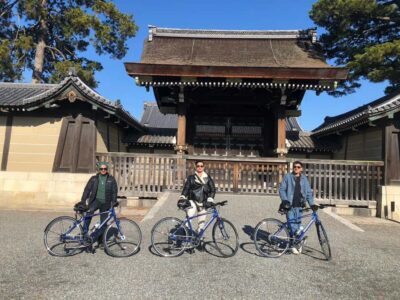
Kyoto: Hidden Gems E-Bike Tour with Local Japanese Guide
Read our review →Browse the lists this ride appears in